increased economic globalization has caused jobs to move to the United States as well as away from it. And because of the higher, increasing productivity of American workers, the jobs that move here pay more than the ones that leave.(via Xander Stephenson via pejmanesque)
Friday, August 20
How Outsourcing Creates Jobs for Americans
Bruce Bartlett says,


Thursday, August 19
The massacre was unavoidable?!
China Ex-PM Moves to Wash Hands of 1989 Massacre, by Benjamin Kang Lim cites Li Peng on the 6/4/1989 massacre:
"Putting down that political disturbance ensured the long-term stability of the country and provided indispensable conditions for China's future development and improvement," Li said, echoing a view shared by a growing number of Chinese.So you see, censorship accomplishes something.
An increasing number believe the massacre was unavoidable and paved the way for the stability and breakneck economic growth that have followed, but many still feel the authorities overreacted by sending in troops with tanks.
Wednesday, August 18
Quick work!
Just days after Edward Cody writes an article celebrating Huang Jingao 黄金高's battle against corruption, he writes another describing the removal of his letter, originally posted on the People's Daily website, and how the commmie party's national publicity department, which is in charge of official censorship, ordered newspapers and broadcasters not to report anything more on him.
Fuzhou city authorities, with jurisdiction over nearby Lianjiang county, announced that Huang, by denouncing corruption, had committed a serious breach of party discipline that could help China's enemies abroad and weaken stability within. Party and government authorities in Fuzhou reached their conclusion at a meeting Friday about the same time Chinese readers were learning of Huang in their newspapers and cheering him on in a flood of Internet postings.This is NOT what it's like under the Bush administration, OK?
Is Kaohsiung really ready?
Kaohsiung looks to Athens games for sports lessons--like what if hardly anyone shows up? Not to mention the public money they're going to pour away on this.
Who's right?
The Marketplace Morning Report for 6:50 had a report (starting at 3:32 minutes into the broadcast) about wind power, mentioning some opposition, but then cited a defender saying that 80% of the British support it. However,
Ministers may be right when they argue that wind power is the only renewable energy source that has even a theoretical chance of meeting the government's targets. Given the costs and technical uncertainties, perhaps it would be better to abandon those targets altogether.
"Social" or "economic" reforms?
NPR's Emily Harris reported on what Linda Wertheimer calls "unpopular social reforms" in her introduction. I'd call them economic reforms. Harris reported
And they explained:
Unemployment across Germany has been above 10 percent for more than five years. Jobs are less of an immediate worry in Sindelfingen since a new labor agreement with DaimlerChrysler guarantees several thousand manufacturing positions at the local plant for the next eight years. But that deal also reflects the growing pressures in Germany. Employees agreed to longer hours after the company threatened to move the work to other plants, including overseas.She really needs to read the Economist to put those longer hours in context. The Economist reports Daimler had sought an increase from Germany's standard 35-hour working week to a 40-hour week, but did not even get that. Even French Socialist Party officials admit
putting the 35-hour week into law was a mistake. It is holding back economic growth and the competitiveness of French firms, scaring off foreign investors and killing job creation.Why is the 35-hour week such a bad idea? Because
In Germany the 35-hour week, introduced in the decade before 1995, is one of many factors that have raised labour costs to levels that have stifled growth and dulled productivity.
Symbolically significant as it became in its own terms, the 35-hour week was also part of a wider European approach to sclerotic labour markets that can now be seen to have comprehensively failed. In many countries besides France, the cure for high unemployment has been sought in the encouragement of shorter working hours. Another common response to growing insecurity about jobs has been to increase job protection and make it harder to fire people. And a widespread reaction to growing global competition that has lowered pay at the bottom end of the market has been to entrench high minimum wages.Harris also states that "Unemployment benefits have also been cut," but offers no figures. Germany's welfare system
As many pointed out at the time, these measures made little sense. The notion that there is a fixed amount of work to be shared out, so that shorter hours for all must mean more jobs, is widely derided by economists as the “lump of labour” fallacy. Making it harder to fire people serves mainly to discourage hiring them in the first place. And high minimum wages translate not into better-paid workers but into more people without jobs. These observations are no longer just matters of theory: the recent experience of France, Germany and other continental European countries shows that they apply in practice too. As the OECD's recent Employment Outlook noted, the empirical evidence points to a clear correlation between high levels of job protection and high levels of unemployment.
Belatedly, Europe's governments are realising this, and coming round to the need to free up their labour markets, not tie them down in even more red tape. Indeed, they have begun to grasp that excessive regulation of labour markets, far from being a sensible response to slower growth, is actually a significant cause of it. Deregulating labour markets need not mean sacrificing all the protections of Europe's social model: countries such as Denmark, Finland and the Netherlands have shown that generous welfare systems and a strong safety net can be preserved even while allowing market forces to play more freely in the demand and supply of labour.
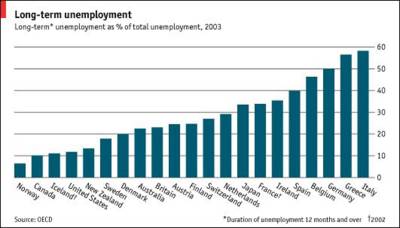
has become a giant insurance policy, designed to cushion living standards. It has proved costly and counter-productive: a large chunk of the unemployment rate reflects the fact that the jobless have little reason to return to work.Earlier, they presented this Long-term unemployment chart
Even compared with those in other generous countries...out-of-work Germans are well protected. People who lose their jobs get unemployment benefit of 60% of their previous earnings (or 67% if they have children) for up to 32 months. After that, payments drop to between 53% and 57%, but have no time limit.

And they explained:
When Americans become unemployed, relatively few stay jobless for long. That is not the case in several European countries such as Italy and Germany. This is one reason why their labour markets are malfunctioning. The longer that people are out of work, the less effectively they compete with those in employment, so overall unemployment has to be higher in order to keep wage inflation under control.Perhaps someone's going to concede that even it's an economic reform, there are social costs. The trouble is, current policy also has a social cost. Yes, I know the people who established the 35-hour week did not intend to raise the unemployment rate, but that's what they did.
Offshoring
Also from the Economist
According to a new study from the McKinsey Global Institute, every dollar of corporate spending shifted offshore by an American firm—mostly, now, to India—generates $1.13 in new wealth for America's economy. However, when a German firm moves a euro to a cheaper place to buy services, its home economy is on average 20 cents worse off...
The biggest difference emerges when workers who have been fired in the offshoring process look for new work. In America, McKinsey estimates that around 70% of workers ousted in favour of offshore alternatives find new work within six months. In Germany, however, the re-employment rate is only around 40%. The reason? Above all, Germany's thicket of labour laws, which discourages firms from hiring workers who may prove a hard-to-shed liability. Admittedly, these same laws—which are increasingly under fire (see article)—also make it harder for German fims to shed workers to take advantage of efficiency-enhancing offshoring. The lesson: offshoring may be an easy target for politicians, but if they have flexible labour markets it may actually be a good thing, not just for big firms, but for everyone.
Tuesday, August 17
At last!
Mister Donut Shops to Open in Taiwan
TAIPEI, Taiwan - Taiwan's President Chain Corp. and Japan's Duskin Co. signed an agreement Tuesday to form a 50-50 joint venture to start a Mister Donut chain in Taiwan.Several years ago the bakery in the basement of the 大力 Isetan dept. store in Kaohsiung made some delicious things something like a cake donut but without the hole. They were absolutely delicious. I keep going back there hoping to find them; no such luck. I hope Donut Sensei donuts are the cake type and not the glazed type, and don't taste like household cleaners. As for crispy creme donuts, they're a little disgusting.
The first store of the venture, called Mister Donut Taiwan Co., will open in Taiwan's capital, Taipei, in the fourth quarter of 2004, the companies said in a joint statement...
President Chain, a unit of Uni-President Enterprises Corp., operates 7-Eleven shops, Taiwan's largest convenience store chain. It also operates Starbucks coffee outlets.
Duskin owns Mister Donut stores in Japan and also makes household cleaning products, ranging from mops and deodorizers to air purifiers.
The President-Duskin partnership expects to open 100 Mister Donut stores in Taiwan within the next five years, said C.Y. Kao, chairman of Uni-President Enterprise Corp.
Mean bastard
I just heard NPR's program arguing that lower calorie diets were not available to those with less money.
In the battle against obesity, it's not just what you eat, but what you can afford. Studies of adjoining rich and poor neighborhoods show obesity rates can differ drastically across economic lines. We look at the dollar and the fight against obesity.The assumption seems to be that a low-carbohydrate diet is the way to go. So how come hi-carb eaters (South & East Asians) are so much thinner than Americans? One woman they interview says that salads are too expensive--$4 a pound. So why not bring your own salad? Make your own sandwich? Bring your own fruit!
Movies
Michael Powell's Contraband (1940) was OK, but nothing special, even if, as Jeff Ulmer says,
The director is again the reaon for having Joseph Losey's lousy Eva (Eve; 1962). We watched the DVD with the original uncut version (poorer quality and with Finnish subtitles), which could have had almost the whole first hour cut. It's nearly unwatchable.
The Lathe of Heaven (the 1980 TV version). Like most science fiction has a good idea that doesn't go much of anywhere. And the plot had an enormous hole in it; if the dreamer could change the world, including the doctor's memory of it, how could the doctor ever figure that out? OK, he witnesses the change once, but after that he apparently remembers what he shouldn't be able to. Still it's interested to see Bruce Davison in something other than the creepy roles I'm used to seeing him in, like The Practice.
We found Ride with the Devil (1999) watchable, even though some critics disliked it because it did not take a stand against slavery. Roger Ebert similarly can't figure out why a former slave would fight on the southern side, even though the film makes clear it's out of personal loyalty. It seems to me as if both he and J. Hoberman didn't much like the movie because they couldn't find any symbolism or irony to make themselves look clever. Or one could say that the movie wasn't deep enough for them. The language I found overly quaint; it makes you wonder if Ang Lee has a tin ear. And then I kept expecting Tobey Maguire to turn into Spidey.
Speaking of other roles, it's a good thing I didn't watch The X Files much, because Gillian Anderson plays the lead role in The House of Mirth (2000). It's a good movie, but I can't help but feel that Anderson's Lily Bart brought it on herself by gambling.
What makes the film unique is that Powell uses the confusion and blackout conditions as a tool for his characters to move around in...Clearly the reason the library has it is just because of the famous director.
The director is again the reaon for having Joseph Losey's lousy Eva (Eve; 1962). We watched the DVD with the original uncut version (poorer quality and with Finnish subtitles), which could have had almost the whole first hour cut. It's nearly unwatchable.
The Lathe of Heaven (the 1980 TV version). Like most science fiction has a good idea that doesn't go much of anywhere. And the plot had an enormous hole in it; if the dreamer could change the world, including the doctor's memory of it, how could the doctor ever figure that out? OK, he witnesses the change once, but after that he apparently remembers what he shouldn't be able to. Still it's interested to see Bruce Davison in something other than the creepy roles I'm used to seeing him in, like The Practice.
We found Ride with the Devil (1999) watchable, even though some critics disliked it because it did not take a stand against slavery. Roger Ebert similarly can't figure out why a former slave would fight on the southern side, even though the film makes clear it's out of personal loyalty. It seems to me as if both he and J. Hoberman didn't much like the movie because they couldn't find any symbolism or irony to make themselves look clever. Or one could say that the movie wasn't deep enough for them. The language I found overly quaint; it makes you wonder if Ang Lee has a tin ear. And then I kept expecting Tobey Maguire to turn into Spidey.
Speaking of other roles, it's a good thing I didn't watch The X Files much, because Gillian Anderson plays the lead role in The House of Mirth (2000). It's a good movie, but I can't help but feel that Anderson's Lily Bart brought it on herself by gambling.
Monday, August 16
Democratic hypocrisy
Christopher Hitchens in the NYT Book Review gives us this quote from Kerry:
If we hadn't voted the way we voted, we would not have been able to have a chance of going to the United Nations and stopping the president, in effect, who already had the votes and who was obviously asking serious questions about whether or not the Congress was going to be there to enforce the effort to create a threat.Was that ever a Kerryism of the Day? Hitchens also wonders,
To hear Kerry speak in Boston, you could draw the conclusion that past military service is not just a good qualification for the presidency, but the equivalent of a necessary condition. If this is true now, why was it not so true in 1996 or 1992?Yeah, it's pretty funny to see many Democrats insisting on how military experience is indispensible in a president. Both of these points have occurred to me before, but merely suggest that Kerry is not much different than Bush.
What is Liberal Studies?
The NYT (above) identifies Hitchens as,among other things,"a visiting professor of liberal studies at the New School University". What is Liberal Studies? The New School University explains,
The Liberal Studies curriculum offers graduate training in intellectual history, cultural studies, and the art of fine writing, bringing together students of social thought, philosophy, the arts, and current affairs who wish to work on the quality of their prose while simultaneously learning to master new modes of serious inquiry, both academic and journalistic. Among the program’s faculty are distinguished writers as well as accomplished scholars. Special attention is paid to the main currents in Western thought—and also to the cutting edge of modern critical and multicultural theorizing.Not so different from Bartleby.com's definition of liberal arts
Academic disciplines, such as languages, literature, history, philosophy, mathematics, and science, that provide information of general cultural concernor as m-w.com defines it,
the studies (as language, philosophy, history, literature, abstract science) in a college or university intended to provide chiefly general knowledge and to develop the general intellectual capacities (as reason and judgment) as opposed to professional or vocational skillsI've got to say I'm more and more concerned about the lack of skills involved, not to mention the fact that "the cutting edge of modern critical and multicultural theorizing" does not, in my experience, contribute anything to enhancing developing reason and judgment--rather the opposite. A lot of modern theory seems aimed primarily at either celebrating certain historically oppressed or marginalized groups, mainly limited to the categories of race (anything but white), gender (which usually seems to mean something connected with women or gays), or class (working class), or castigating their oppressors (white heterosexual upper- or middle-class males) while ignoring other avenues of analysis.
Saturday, August 14
酒香不怕巷子深
"The quality of your product compensates for other shortcomings", or words to that effect. Apparently it's a fairly recent mainland saying.
China?
Sniping from China and DPP legislator drives out TV host
Aside from the bad habit of stirring up ethnic hatred that some pan-green people have, and aside from the question of the DPP's (backed by Chen Shuibian) using CTS to further its political influence over the media, it looks like Chiang Hsia may have decided not to run the station into the ground. Surprise, surprise. Or maybe rules count for something in Taiwan. That would be a bigger surprise.
Popular talkshow host Wang Ben-hu (汪笨湖) quit his job at the Chinese Television System (CTS) late last night after accusations by Democratic Progressive Party Legislator Shen Fu-hsiung (沈富雄) that his program was sparking ethnic conflict.By China, they clearly mean CTS, unless commie China's regulations now apply to Taiwan.
Wang issued a statement announcing he had resigned from the show, Taiwan Advancement, also citing China's new ban on entertainers appearing on CTS as one of the reasons.
CTS canceled long-running soap operas to give the valuable 8pm slot to Wang's political commentary program."Resigned", Ha! I bet he was pushed.
"Since I started the program here, I have caused CTS president Chiang Hsia (江霞) a great number of problems. I am willing to resign in order to restore harmony [to CTS]," he said in a statement.
Aside from the bad habit of stirring up ethnic hatred that some pan-green people have, and aside from the question of the DPP's (backed by Chen Shuibian) using CTS to further its political influence over the media, it looks like Chiang Hsia may have decided not to run the station into the ground. Surprise, surprise. Or maybe rules count for something in Taiwan. That would be a bigger surprise.
Friday, August 13
程建人
In Chen Chien-jen upbeat on his posting to the EU, Melody Chen writes,
After announcing the cancelation of former foreign minister Eugene Chien's (簡又新) appointment as representative to the EU, Minister of Foreign Affairs Mark Chen (陳唐山) confirmed late on Wednesday night that Chen Chien-jen would fill the vacancy...It sounds like he's being hung out to dry. And none too soon. Earlier a Taipei Times Editorial wrote,
Asked whether the canceling of Chien's appointment was a result of the UK representative office's blunder in issuing a passport and legal documents to Yeh Hsiu-chen (葉秀貞), wife of fugitive murder suspect Andrew Wang (汪傳浦), Mark Chen said: "I don't know. I cannot say."
Mark Chen's comments seemed to contradict his position on Wednesday, in which he strongly hinted that there was a link.
The foreign minister apparently did not indicate to Chien that his appointment had been canceled prior to his announcement at the press conference on Wednesday afternoon.
Learning the information from reporters, Chien phoned Mark Chen after the press conference but the minister was said to have missed the call.
When Taiwan's representative office in Britain issued a new passport and documents authorizing real estate transfers to Yeh Hsiu-chen (葉秀貞), the wife of Andrew Wang (汪傳浦), who is wanted for his involvement in the Lafayette scandal, it caused a political storm.That's pretty negative. Let's see if the DPP resurrects him again. I hope not, but if they did, it wouldn't be the first time. As to Chen Chien-jen, the Taipei Times elsewhere admits that both Taiwan's new de-facto ambassador to the US, David Lee (李大維) and Chen are "stalwart Chinese Nationalist Party (KMT) member[s]" and conceded that David Lee "was chosen because of his wide-ranging diplomatic experience and expertise". Well, I hope these two aren't corrupt. Certain DPP elements despise the KMT so much, they won't trust anyone from there...except Lee Teng-hui.
The entire country is now wondering how such a mistake could occur, not once, but twice.
Pan-blue legislators have raised tough questions that suggested the scandal was not just a mistake, and the Taiwan Solidarity Union's (TSU) legislative caucus has reported the issue to the Control Yuan, asking it to investigate the officials handling the matter: Tien Hung-mao (田弘茂), Taiwan's representative to Britain, and former foreign minister Eugene Chien (簡又新).
...before becoming foreign minister, Chien had to resign from his post as transportation and communications minister in connection with corruption surrounding highway construction projects. However, coming from a respected Taoyuan family adept at manipulating private relationships with high-level leaders, Chien was still trusted and given important posts by two consecutive presidents, even after his resignation. He advanced quickly in rank....
Thursday, August 12
The Atheist Sloth Ethic and the Spirit of Collectivism
Niall Ferguson suggests that Europeans work less because they're atheists.
You see, the most remarkable thing about the transatlantic divergence in working patterns is that it has coincided almost exactly with a comparable divergence in religiosity, both in terms of observance and belief.Bollocks! Correlation is not causation. (Not that I have anything against atheism--or sloth.)
According to the Gallup Millennium Survey of religious attitudes (conducted in 1999), 48% of people in Western Europe nowadays almost never go to church; the figure for Eastern Europe is just a little lower at 44%. In the Netherlands, Britain, Germany, Sweden and Denmark, less than one in 10 of the population now attends church at least once a month. Only in Catholic Italy and Ireland does more than a third of the population worship once a month or more often.
By contrast, more than twice as many North Americans as Europeans attend religious services once a week or more.
Irony I
I found Douglas Sirk's Written on the Wind (1956) overblown. According to Roger Ebert, many elements of the movie, such casting half out of the closet Rock Hudson as one of the male leads are supposed to be snarky commentary on American society:
...surely Sirk was smiling when he directed it; he's subverting the very lifestyle he celebrates. His use of artificial and contrived effects, colors and plot devices is "a screaming Brechtian essay on the shared impotence of American family and business life," says film critic Dave Kehr, and encompasses deliberate distancing "that draws attention to the artificiality of the film medium, in turn commenting on the hollowness of middle-class American life".If that's the case, then what about All That Heaven Allows (1955), similarly brimming with "artificial and contrived effects", but where Rock Hudson plays the free spirit, and promotes Thoreau's Walden? Isn't that making fun of people who give up the middle-class life? Oh, I see: when it's the bourgeoisie, he's making fun of it, but he would never ridicule the sainted bohemians. The other thing about both movies is even though Lauren Bacall, Dorothy Malone, and Rock Hudson were all around 30 in the later movie, the two women looked too old. On the other hand, Jane Wyman was about the right age for her role in the earlier movie.
Irony II
We saw the DVD of The Sand Pebbles (1966). It was interesting to see if we could recognize anything in Taiwan, where it was filmed. Some of the river scenes looked like Tamsui, but the director Robert Wise and the actors interviewed (Richard Crenna, Candice Bergen, and Mako) identified one setting as Tamsui one time and Keelung the other. Of course Candice Bergen in particular wanted to make it all about Vietnam. Despite big talk about what great friends everyone was, Mako was the only one to mention the actress who played the Chinese girl Maily, saying she kept to herself.
It turns out that she is Maryat Rollet Andriane (aka Emmanuelle Arsan), and had already written Emmanuelle as we see from this site, which shows her topless on a couple of book covers. Yep, if the gossip on the web is right, she's the Thai, possibly Eurasian, who married her husband, Louis-Jacques Rollet-Andriane (at one time Special representative of the Director of the International Council of Monuments and Sites of UNESCO) when she was sixteen, and later went on to create the Emmanuelle franchise. I guess her fellow actors were embarrassed by that or something else she did while they were filming in Taiwan. She didn't have much of a role, but she did OK with it.
If we can laugh at homosexual Rock Hudson playing the hetero love interest in the fifties movies, maybe we can laugh at the fact that even when she played the good girl, she got to show a little skin (when the baddies lifted her shirt, which showed her bra).
It turns out that she is Maryat Rollet Andriane (aka Emmanuelle Arsan), and had already written Emmanuelle as we see from this site, which shows her topless on a couple of book covers. Yep, if the gossip on the web is right, she's the Thai, possibly Eurasian, who married her husband, Louis-Jacques Rollet-Andriane (at one time Special representative of the Director of the International Council of Monuments and Sites of UNESCO) when she was sixteen, and later went on to create the Emmanuelle franchise. I guess her fellow actors were embarrassed by that or something else she did while they were filming in Taiwan. She didn't have much of a role, but she did OK with it.
If we can laugh at homosexual Rock Hudson playing the hetero love interest in the fifties movies, maybe we can laugh at the fact that even when she played the good girl, she got to show a little skin (when the baddies lifted her shirt, which showed her bra).
Why did he kill them?
Public Access (1993) Directed by Bryan Singer and co-written with Christopher McQuarrie (who were also resposible for The Usual Suspects) was an incoherent mess.
Commies vs. Christians
In Soothing Hong Kong With Symbols: Bible Exhibit Is Latest Gesture by Beijing Since April Decision to Stifle Democracy, Edward Cody writes
The two antique volumes were among dozens gathered by China's officially sanctioned Christian churches and put on display in Hong Kong's sleek harbor-side convention center. It was the Communist government's latest gesture to reassure this former British colony, particularly its 600,000 Christians, that being ruled by Beijing is nothing to fear.Unless they are members of the independent church, as CHRISTOPHER BODEEN wrote in Chinese Sentence Three Church Activists:
A Chinese court on Friday sentenced three activists in the independent Protestant church to up to three years in prison for leaking state secrets, a court official and overseas church activist said.The crime? They were declared
guilty of passing on information to an overseas magazine about a court case involving another member of the independent church...[and] of passing on information about the destruction of unofficial churches outside Hangzhou in a crackdown last year....Well, that's reassuring.
Subscribe to:
Posts (Atom)