...now I walk through a shadowed valley of epistemological doubt. If I'm not an expert on a subject, I try to avoid having firm opinions about it. However, that's sort of unfortunate since democracy thrives when citizens are able to debate a broad range of subjects rather than deferring to the judgment of the experts.Yeah, and share our ignorance.
So, is there anything we can do about this as citizens? I'm not so sure. I think the best advice I have is that everyone should start their own blog.
Wednesday, August 11
The valley of epistemological doubt
David Adesnik writes


Smug lefties
Reihan writes,
I grew up among smug lefties; and to this day, I know a disproportionately large number of smug lefties. I know a handful of smug right-wingers, but the vast majority of right-wingers I know, and I realize that this is almost certainly atypical, are thoughtful, open-minded, self-effacing, self-critical, and susceptible to evidence and persuasive argument. I mean, this is probably because I know, like, eight people who can be described as right-wing, nine if I count “knowing myself,” and several of the others are economists.I'm in a similar situation, except the only right-wingers I know are Clinton-hating Neanderthals. I don't think I've ever met a "neo-liberal" in the flesh.
Ah, Limburger!
Teresa Heinz Kerry ordered a Limburger cheese sandwich with raw onions and mustard on rye bread.It sounds good, but I'd like tomato on mine. It's all very well to laugh at the politicos, but it's a shame some people seem to wish they'd eat something more middle American. Anyway, it's a good thing she didn't put ketchup on it.(via Dr. Weevil, whose tastes are pretty narrow and The Big Trunk)
Liars
Those evil liberals at the Annenberg Public Policy Center's FactCheck.org criticize Kerry's talking down the economy using dubious statistics.
When he formally announced his candidacy in September 2003 he claimed the nation was suffering the "greatest job loss since the Great Depression," which we pointed out was not true. Now he's saying that the jobs the economy is adding are paying $9,000 less than the jobs they replace. That's not a fact, either.and when Kerry blames the corporate tax code for shipping jobs overseas, they say
...economists say "outsourcing" jobs overseas is a minor problem that Kerry's plan wouldn't do much to fix.Whose side are they on, anyway? Of course, as Spinsanity has pointed out, both Kerry and Bush are liars.
...recent Labor Department data underscore what even Democratic economists have said for some time -- outsourcing jobs overseas, or "offshoring," accounts for just a small fraction of the many millions of jobs that are lost each year even in a good economy.
Saturday, August 7
No flags?
According to the Taipei Times
[Taiwan's] representative office in Athens cautioned Taiwanese watching the [Olympic] Games in the city against waving any flag apart from the Taiwanese delegation's official flag, which was approved by the International Olympic Committee.Many pro-independence people, no fans of the ROC flag, are sure to fall in love with it now. But such bullying by the mainland is hardly going to win friends amongst those in favor of the status quo and at the moment opposed to independence. (Maybe the commies are trying to goad the Taiwanese into independence?) Meanwhile, when Japan Sinks Arch-Rival China as Trouble Flares at the Asian Cup final,
Differing from the national flag of the Republic of China, the Taiwanese delegation's official flag consists of five rings and a plum blossom, the country's national flower. The delegation is formally registered as the "Chinese Taipei" team.
"If our citizens wave other flags to cheer our up team in the Games, security guards may stop their behavior or even drive them out," the representative office warned in a statement.
Chinese fans vented their fury at the final whistle after Japan scored twice in a controversial second half, one group of several hundred hurling bottles and burning Japanese flags.So because of Japanese wartime atrocities, in China it's OK to burn the flag of the Japanese when they win a soccer game, but it's not OK to burn the flag of the communist government, which is probably responsible for inflicting even more suffering on its own people than the Japanese. Meanwhile, in an athletic competition in a foreign country, waving the flag of the defeated civil war enemy of that same murderous and now corrupt communist government is also taboo, even though the Taiwanese people that enemy now governs have democratically elected it. Hello, international outrage? Oh, that's right. It's only a wrong if the US commits it.
Vietnam
I'm more pathetic than Lileks who says in his discussion of the war in Vietnam
Later it was a Symbol and a Warning – a reminder of American failings, not American failure. It was a template, too; every war wa seem through the terms of Vietnam, which for us meant THE DRAFT, the ultimate mellow-harsher. Most of my reflexive anti-militarism of the early 80s came not from any deep-seated conviction about the ethics of force, but from a desire to stay in coffeehouses smoking cigarettes and reading books as long as I wanted to. It was selfish and cowardly, but I had a vast body of literature and philosophy to help me convince myself otherwise.I was opposed to the war and to militarism in general because my parents were (and remain) pacifists. I'm not sure I was right anymore.
Friday, August 6
Crack
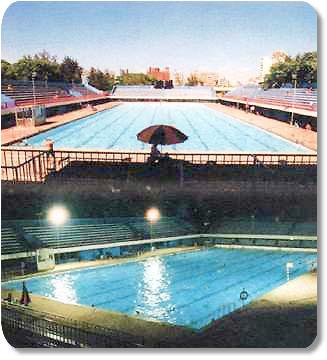
My neck started cracking many years ago once I did some neck-bending exercises (left/right) I saw in a book. Several years ago, I started swimming, and I'd worked my way up to a mile a day freestyle as many as five days a week, but I stopped swimming temporarily because I got a discoloration (it didn't itch or otherwise feel different) that started on the inside of my calves and started spreading to my thighs. It started in Taiwan at the Kaohsiung 前金游泳池 (pic below from here make it look a little nicer than it is), so I wonder if it wasn't a problem with their pool maintenance, but after two days in the local pool, it got still worse. After several days of not swimming, it went away. Now I walk instead, but my neck cracks sometimes again.

Update
I thought I should add that at the 前金 pool they never seem to put up the lanes, the pool itself does not seem all that clean, and the changing rooms are pretty grotty.
Update
I thought I should add that at the 前金 pool they never seem to put up the lanes, the pool itself does not seem all that clean, and the changing rooms are pretty grotty.
The Splittist Entity
I only just found the transcript of The European Pulse, a CNN program aired Friday June 25 (and that I mentioned here). The "distinguished" novelist Frederick Forsyth (I didn't realize he was distinguished--maybe that just means "old") was one of a number of panelists. In response to the moderator Richard Quest's question, "How will history judge this moment and this war?" he says,
Broadly speaking, history judges things benignly when they succeed. And is hypocritical when they fail. So the jury is still out. We don't know whether this massive experiment will succeed of fail. If it fails, and Iraq lurches back into anarchy and chaos and civil war, then history will condemn every single thing that we did for the past 14, 15, 18 months. But if it succeeds, then doubtless Mr. Blair will be regarded as a statesman.In response to Lilli Gruber, an Italian "prominent former broadcaster" and now an elected member of the European Parliament, who asked,
The question is, how long is it going to take until we can say it was a success? That's the question, excuse me. Does it take 10 years, 20?Forsyth replies
Richard, what we are witnessing is a regime change in Iraq. It's the seventh in my lifetime. And I don't remember anyone making a fuss about the first six.When asked whether what has taken place in Iraq is right from the standpoint of realpolitik rather than morality, he responded,
...If you're talking realpolitik, then I'm amused and puzzled by Lilli and her...regret for the Iraqi war because I remember Italian forces flying wingtip to wingtip, and indeed, the Iron Cross of Germany flying wingtip to wingtip with the world air force when we bombed Serbia back to the stone age in order to spare the Kosovan people from the pogroms of a dictator called Milosevic...Asked if it was just about getting rid of a dictator, is that morally sufficient? He responds,
I don't remember Italy objecting to that liberation. I don't remember Germany objecting to that liberation. I certainly do recall the Foreign Legion being side by side the British Tommies, waiting in the Albanian fields to invade Kosovo. Now as that was not sanctioned by the United Nations either, one wonders why one is so moral and the other is immoral? That's all.
Really it depends, really on what attitude you have toward the hypocrisy of power politics. We got rid of Milosevic, no question about that, and really it was in fact, NATO, the European wing of NATO, asking the Americans to help, which they did.In the same program, Niall Ferguson argues that
We also liberated the people of East Timor. And nobody, as far as I recall, complained about that.
Americans unilaterally deposed a dictator in in the island of Grenada and later another one in the Republic Panama. And nobody that I recall complained much about that.
So in other words, we do select our dictators, those who should properly be deposed and those who really should be allowed to get on with it.
One last thing, if I may, about the hypocrisy within Islam because this Sunni Muslim dictator actually wiped out, with the assistance of General al-Majid, 100,000 Shi'a Muslims. And do you know what the reaction from Islam was? Stunning, total, deafening silence.
from the military point of view, it was clear that it didn't need any European involvement at all, didn't really need British military involvement, as Donald Rumsfeld also said in a rather unguarded moment. But from the point of view of legitimacy, legitimacy being a far more important thing in this situation than military capability, it desperately did need some kind of European involvement.When the moderator asks what Europe can do to influence the United States, Nicole Bacharan, a French political scientist replies,
There are things that can be done. I mean, the United Nations resolution was one step, even if it's not much help. It does bring legitimacy. And you have a number of social and economic ways of helping, and helping the Iraqis finding their step on the international scene.So with out the blessing of the UN, there is no legitimacy. By this logic, since the UN does not recognize Taiwan, Taiwan is not a legitimate entity. Let's see, if Israel is "the Zionist entity, let's make Taiwan "the splittist entity".
Thursday, August 5
Rainmakers
Chinese Rainmakers Competing for Clouds by Edward Cody
...rainmakers across China have accumulated more hands-on practice than their counterparts elsewhere, wringing water from the clouds for season after season in intense government-sponsored programs....[However,] years of research have showed that even the best efforts of China's rainmakers produce only a 10 percent or 15 percent increase in rainfallWater is too cheap.
Where's the international outcry?
In India, Torture by Police Is Frequent and Often Deadly
"India has the highest number of cases of police torture and custodial deaths among the world's democracies and the weakest law against torture," said Ravi Nair, who heads the South Asia Human Rights Documentation Center. "The police often operate in a climate of impunity, where torture is seen as routine police behavior to extract confessions from small pickpockets to political suspects." He said that laws governing police functions were framed under British colonial rule in 1861 "as an oppressive force designed to keep the population under control."...Emphasis mine. That is, torture is not just inhumane, it doesn't necessarily even get information.
Although the Indian government signed the international Convention Against Torture in 1997, it has not ratified the document. Some members of Parliament have argued against ratification, saying they oppose international scrutiny and asserting that Indian laws have adequate provisions to prevent torture...
Some police officers justify the use of torture to extract confessions and instill fear.
"The police in India are under tremendous pressure, as people need quick results. So we have to pick up and interrogate a lot of people. Sometimes things get out of control," said Raghuraj Singh Chauhan, a newly assigned officer at the station where Rajeev Sharma died. "After all, confessions cannot be extracted with love. The fear of the police has to be kept alive -- how else would you reduce crime?" he added, fanning himself with a police file folder.
A senior police officer in Meerut, on condition of anonymity, openly discussed torture methods with a visiting reporter. One technique, he said, involves a two-foot-long rubber belt attached to a wooden handle.
"We call this thing samaj sudharak," the officer said, smiling, using the Hindi phrase for social reformer. "When we hit with this, there are no fractures, no blood, no major peeling of the skin. It is safe for us, as nothing shows up in the postmortem report. But the pain is such that the person can only appeal to God. He will confess to anything."
Last September, in a written ruling in a case of police misconduct, the Supreme Court criticized the use of torture. "The dehumanizing torture, assault and death in custody which have assumed alarming proportions raise serious questions about the credibility of the rule of law and administration of the criminal justice system," the court said. "The cry for justice becomes louder and warrants immediate remedial measure."
In addition, the severity of the torture problem is probably worse than statistics indicate, because victims, fearing reprisals, rarely report cases against the police, human rights advocates said.
Sunday, August 1
Which language?
Foreign brides face language gap
The language barrier is the biggest problem faced by some 300,000 foreign brides, the Eden Social Welfare Foundation said yesterday.So which Chinese is the (Christian) 伊甸總會 promoting? Mandarin or Taiwanese? Will the brides get a choice based on the language primarily spoken by their husband's family? It does little good to insist on one or the other. The stereotype is that many husbands are retired soldiers from the mainland, but there are probably a fair number of benshengren.
The foundation said that because foreign brides often encounter language problems and strained relations with their mothers-in-law, it will offer free Chinese-language classes to foreign brides and provide counselling to help them adjust to life in this country.
程益中
I was a little surprised at EastSouthWestNorth's readiness to accept at face value the corruption charges against Cheng Yizhong (程益中). Philip P. Pan has an article (In China, an Editor Triumphs, and Fails) that gives some background about the case. An article in his paper led to an exposé of "abuses in a nationwide network of detention camps that purchased and sold inmates like slaves" which led to the abolishment of the detention system, depriving "police agencies, a powerful branch of the state, of a lucrative source of income. More important, the story had embarrassed local leaders..." As far as the charge of corruption goes, the article merely says
...the amount of money involved was relatively small. Journalists across the country signed petitions in protest, and many who had campaigned against the detention law began lobbying on behalf of the Southern Metropolis Daily.Given the circumstances, I'm more likely to suspect the Chinese authorities of unfairness than blame Cheng. Maybe he'll be freed as the jailed Jiang Yanyong was.
Cheng remains in prison but has not yet been charged with a crime, a sign that party leaders have not decided what to do.
The Southern Metropolis Daily is still publishing, but editors are more careful about criticizing local authorities. Almost all of the paper's key ad salesmen have resigned, and dozens of reporters have quit. In the first quarter of the year, officials said, the paper lost $1.5 million.
But the new tabloid started by Cheng in Beijing has adopted the aggressive style of the old Daily and appears to be prospering.
九層塔
In Taiwan basil is known as 羅勒 or more commonly 九層塔; I prefer the latter name, which means nine level pagoda, from the shape of the leaves. Apparently what we here in the midwest call "basil" is Ocimum basilicum, or Sweet Basil. The leaves are extremely fragrant, more fragrant than what they sell in Taiwan. However, when cooked, the Taiwanese basil is tastier than the American variety. Since it's often used in Thai dishes (with seafood), I'm guessing it's Ocimum basilicum 'Thyrsiflora', or Thyrsiflora Basil, which this site identifies as the one "used in Thai cooking". This site mentions Thai Basil, 'Horapha Rau Que', (Ocimum thyrsiflora), and explains thyrsiflora means flowers arranged in a thyrse (a flower cluster with a central spike that has side branches also clustered with flowers).
Once in the Chinatown grocery in Paris we bought something that we hoped was going to be Thai basil, but was actually 魚腥草 (literally fish-stink grass; Houttuynia cordata). I thought it was mostly a Vietnamese thing, because the Paris Asian community is mostly Southeast Asian (and according to this site, it's known as Vap ca, Fish mint, fishscale mint.

Once in the Chinatown grocery in Paris we bought something that we hoped was going to be Thai basil, but was actually 魚腥草 (literally fish-stink grass; Houttuynia cordata). I thought it was mostly a Vietnamese thing, because the Paris Asian community is mostly Southeast Asian (and according to this site, it's known as Vap ca, Fish mint, fishscale mint.
The heart-shaped leaves of this herb have an unusual slightly sour, fishy flavor. Some folks love rau diep ca's tangy qualities and others focus on its unusual fishiness.No kidding. In fact, it's also found in China, where it's called 摘耳根. This guy tells how when he tasted the fishy and rusty taste, he wanted to spit it out. It's also grown in Taiwan, although it's not widely available commercially. The pic below comes from this site, which calls it pig thigh; it's got a pinkish tinge we didn't see in Paris.

Saturday, July 31
bureaucratic risk-aversion
Tyler Cowen argues, bureaucratic risk-aversion
brings groupthink, excess formalism, protecting against yesterday's threat, and an unwillingness to take responsibility for mistakes. Furthermore it can make effective pre-emption virtually impossible; decisionmakers and their allies will no longer trust their intelligence communities.What a great idea. It'll never happen, though.
Rather than making intelligence agencies more accountable, how about making them more independent? Create some small, elite groups and staff them with the best people we can find. Pay them well. Give them [arms]-length protection from political pressures....Give them a culture of internal pride.
Maybe Taiwan should try a similar argument
Tim Cavanaugh, writing on Hawaiian independence, remarks he
...wouldn't mind losing the eyesore of the poorly scaled island chain inserted into the lower left corner of the U.S. map, where it ends up looking like a dropping behind the steer shape of the lower 48.But what does Taiwan look like next to the big chicken?
Professor Morton Masius
It was only a few years ago that when I was reading about Max Planck and his stating that "A new scientific truth does not triumph by convincing its opponents and making them see the light, but rather because its opponents eventually die and a new generation grows up that is familiar with it" (Scientific Autobiography and Other Papers) that I realized Professor Masius had translated Planck's Theory of heat radiation. I knew he had worked on a couple of physics texts, but I don't remember him ever mentioning Max Planck. I have only just discovered that in addition, he also translated Louis Rougier's La matérialisation de l'énergie as Philosophy and the new physics; an essay on the relativity theory and the theory of quanta. Here's a review from The American Mathematical Monthly, Vol. 28, No. 11/12. (Nov. - Dec., 1921), p. 455:

The only philosophers I ever recall him mentioning were John Stuart Mill, and possibly, Bertrand Russell. In any case, he would have been uncomfortable with Rougier's involvement with the Vichy government and later the French right wing. As I recall, the Professor was a yellow dog Democrat and a typical liberal in the American sense. I don't think he'd have much liked Rougier's "neo-liberalism."
I found out a little about Rougier's later career from Investigating Rougier (pdf), by Mathieu Marion. It was interesting to learn that the journalist Walter Lippmann was an exponent of traditional economic liberalism, like Ludwig von Mises and Friedrich von Hayek, with whom Rougier associated, and that he was also influenced by Lucien Lévy-Bruhl's idea of mentalité. (In fact, mentalité also helps explain Planck's problem in getting his ideas accepted.) Marion tries to put Rougier's contribution into perspective, and argues that a lot of the hostility against him is due to the fact that he was a logical empiricist and a neo-liberal, and French philosophers are hostile to empiricism, logic and liberalism.
Update
The Rougier translation is found in over 100 libraries worldwide, whereas the
Planck translation is found in over 600, and was republished in 1988. A search for Morton Masius at Amazon.com turns up History of Science in the United States: An Encyclopedia by Marc Rothenberg, which has this excerpt:
Upupdatedate
Here's something one of the Professor's granddaughters wrote about Edith Bailey Masius:
upupupdate
Morton Masius was born in 1883 and died in 1979. Since the above was written, Vera Mildred Masius and Marguerite have both died.
Further updates, from a transcript of the Wellsboro Agitator mentioned above:
1880-08-24
Married at Stony Fork Apr 28 1880 by Rev. J. A. Boyce, Mr. Edmund A. Masius and Miss Edith A. Bailey.
1889-04-30
Mrs. Edith Bailey Masius, who is well known in this borough, ws married on the 8th instant to Mr. Bernhard Liebisch, at Leipsic, Germany.
1892-05-04
Dead in Germany - Last Friday a dispatch was received here announcing the death of Mrs. Edith Bailey Liebisch at Leipsic, Germany that morning. She died of consumption with which disease she had been suffering for months. Mrs. Liebisch was the daughter of John W. Bailey. She went to Leipsic about five years ago to study in the university intending to fit herself for a teacher. Soon after she met Prof. Bernard Liebisch, a dealer in rare books and they were afterward married. When her health began to fail her sister Miss Mildred Bailey went to her and has ministered to her during her sickness. Mrs. Liebisch was nearly thirty three years of age. She leaves three children, two of them by a former marriage with Mr. Masius.
And here's his obituary from Physics Today -- April 1980:


The only philosophers I ever recall him mentioning were John Stuart Mill, and possibly, Bertrand Russell. In any case, he would have been uncomfortable with Rougier's involvement with the Vichy government and later the French right wing. As I recall, the Professor was a yellow dog Democrat and a typical liberal in the American sense. I don't think he'd have much liked Rougier's "neo-liberalism."
I found out a little about Rougier's later career from Investigating Rougier (pdf), by Mathieu Marion. It was interesting to learn that the journalist Walter Lippmann was an exponent of traditional economic liberalism, like Ludwig von Mises and Friedrich von Hayek, with whom Rougier associated, and that he was also influenced by Lucien Lévy-Bruhl's idea of mentalité. (In fact, mentalité also helps explain Planck's problem in getting his ideas accepted.) Marion tries to put Rougier's contribution into perspective, and argues that a lot of the hostility against him is due to the fact that he was a logical empiricist and a neo-liberal, and French philosophers are hostile to empiricism, logic and liberalism.
Update
The Rougier translation is found in over 100 libraries worldwide, whereas the
Planck translation is found in over 600, and was republished in 1988. A search for Morton Masius at Amazon.com turns up History of Science in the United States: An Encyclopedia by Marc Rothenberg, which has this excerpt:
The [translation] into English of the second edition of Planck's [Wärmestrahlung] by the American Morton Masius in 1914 encouraged the introduction of quantum theory into the curriculum of universities in the United States.
Upupdatedate
Here's something one of the Professor's granddaughters wrote about Edith Bailey Masius:
Her son Morton was my grandfather. She was married to Alfred (or Albert, or Edmund, unclear! ) Masius near Wellsboro some time @ 1880, against the wishes of her family. They had two sons, Roderick and Morton, both born in Egg Harbor City, N.J. When the boys were young, Edith and Alfred (?) divorced (shocking for the time) and Edith moved to Leipzig Germany to study the new field of experimental psychology with Willem Wundt (at the time she was his only American woman student.) The boys went to the school attached the famous church where J.S. Bach was organist and choir director. Edith remarried, to Bernard Liebisch, who was a widower. They had a daughter Mildred (called in the family 'little Mildred', to distinguish her from Big Mildred, Denver Mildred etc.). Edith never returned to the U.S. Edith became ill and on her deathbed extracted a promise from her younger sister Mildred to care for her boys. Mildred Bailey gave up her own engagement (to a man in the Wellsboro area) to remain in Germany caring for the boys. She married her sister's husband Bernard Liebisch. They had a son, Arnold Llewellyn.
Roderick married a woman called Lillian, they are in the 1920 U.S. census enumeration, shown as living in St.Louis. As far as I know they had no children. Family lore has it that he killed himself after being caught robbing the mails. Certainly he asked his brother Morton for money frequently.
Morton stayed in Germany, married a German woman, Paula Marie Wagner (my grandmother), from a wealthy family in Leipzig-Gohlis. He studied chemistry at the University of Leipzig, earning his Ph.D. in Chemistry in @ 1907. Paula also was a Ph.D. student in Chemistry, the first woman in that department at the university. After a two year Fellowship in the U.S. at Harvard, Morton went back to Germany. He and Paula married in 1910, and came to the U.S. where Morton took a position as Professor of Physics at Worcester Polytechnic in Worcester MA. My mother Vera Mildred Masius was born in Worcester in 1919; her older sister Marguerite was born in Worcester in 1917. They are both alive, Marguerite lives in Paris with her husband Robert Hammond and my dad, Alan D. Ferguson, died a number of years ago. My mother lives nearby here in Lexington, MA. There is a slew of kids and grandkids.
My grandparents never went back to Germany to live, since WWI broke out soon after and it became impossible. My mother believes that she has Liebisch cousins in Germany, but because Leipzig was in East Germany, and due to the chaos of WWII, she has never been able to find out.
My mother also has wondered what happened to the mysterious Masius. I located a story in the Washington Post from 1907 when a Rosa E. Masius committed suicide and the police suspected her husband Alfred G. Masius. They appear to have lived in D.C. from at least 1890. (He was released by the police and never charged!) So, any more information on him would be welcome. An Alfred G.Masius shows up as a newly naturalized citizen age 24, emmigrated from France around 1879, but the dates don't match up with the husband of the dead Rosa. An Edith A. Bailey shows up in the Wellsboro Agitator as marrying an Edmund A. Masius in 1880. Those dates match, but I believe she was the Edith Maud Bailey who was Roderick and Morton's mother. Any more information would be welcome.
upupupdate
Morton Masius was born in 1883 and died in 1979. Since the above was written, Vera Mildred Masius and Marguerite have both died.
Further updates, from a transcript of the Wellsboro Agitator mentioned above:
1880-08-24
Married at Stony Fork Apr 28 1880 by Rev. J. A. Boyce, Mr. Edmund A. Masius and Miss Edith A. Bailey.
1889-04-30
Mrs. Edith Bailey Masius, who is well known in this borough, ws married on the 8th instant to Mr. Bernhard Liebisch, at Leipsic, Germany.
1892-05-04
Dead in Germany - Last Friday a dispatch was received here announcing the death of Mrs. Edith Bailey Liebisch at Leipsic, Germany that morning. She died of consumption with which disease she had been suffering for months. Mrs. Liebisch was the daughter of John W. Bailey. She went to Leipsic about five years ago to study in the university intending to fit herself for a teacher. Soon after she met Prof. Bernard Liebisch, a dealer in rare books and they were afterward married. When her health began to fail her sister Miss Mildred Bailey went to her and has ministered to her during her sickness. Mrs. Liebisch was nearly thirty three years of age. She leaves three children, two of them by a former marriage with Mr. Masius.
And here's his obituary from Physics Today -- April 1980:

Cherries! Pick 'em while they're hot!
Postmodernism encourages people to sift through culture (art, literature, history, etc.) to find something about race, gender (which usually seems to mean something connected with women or gays), or class, or any combination thereof. Then they hold up the handful of examples they find, using them to prove their argument that these various groups have been unjustly oppressed. It's not that I disagree that they've been oppressed, but to me, that's only a tiny part of what most culture is about, so I'm distressed by the way they cherry-pick examples to prove their case.
So it's disheartening to see Bryan Caplan's evaluation of Roderick Long's "Rituals of Freedom: Austro-Libertarian Themes in Early Confucianism" (pdf) as "an amazingly interesting and learned paper". While Long is right about Laozi not being much of a libertarian, his argument that the Confucians are much more supportive of libertarian principles seems to completely ignore the fact that Confucians are far more interested in discussions of morality, and not in a way that generally concerns libertarian principles.
Meanwhile, I'm writing a literature paper now. Writing about literature almost inevitably seems to encourage cherry-picking.
So it's disheartening to see Bryan Caplan's evaluation of Roderick Long's "Rituals of Freedom: Austro-Libertarian Themes in Early Confucianism" (pdf) as "an amazingly interesting and learned paper". While Long is right about Laozi not being much of a libertarian, his argument that the Confucians are much more supportive of libertarian principles seems to completely ignore the fact that Confucians are far more interested in discussions of morality, and not in a way that generally concerns libertarian principles.
Meanwhile, I'm writing a literature paper now. Writing about literature almost inevitably seems to encourage cherry-picking.
十面埋伏
A couple of weeks ago we saw Zhang Yimou's 张艺谋 House of Flying Daggers 十面埋伏. (That's a lousy English title--it sounds like pidgin English.) Zhang's going downhill: it's a very pretty movie, but the plot is silly. Still, the blind bean-shooting scene near the beginning is cute, and the bamboo forest fight is better than Ang Lee's 李安 Crouching Tiger, Hidden Dragon 臥虎藏龍 bamboo fight.
Fafblog
Fafblog via The Peking Duck (no relation) has some good convention blogging. On the non-convention (unconventional?) side, I also liked Gay Marriage Amendment: THE FALLOUT
Subscribe to:
Posts (Atom)