Q: Mr. President, recently the head of the Family Research Council said that judicial filibusters are an attack against people of faith. And I wonder whether you believe that, in fact, that is what is nominating Democrats who oppose your judicial choices. And I wonder what you think, generally, about the role that faith is playing, how it's being used in our political debates right now.Absolutely. I suspect we won't hear much about this from the Bush haters. It's true he may say something else to the religious rightists, but the fact that he said this at all is quite something.
BUSH: I think people are opposing my nominees because they don't like the judicial philosophy of the people I've nominated. And some would like to see judges legislate from the bench. That's not my view of the proper role of a judge.
Speaking about judges, I certainly hope my nominees get an up-or- down vote on the floor of the Senate.
They deserve an up-or-down vote.
I think, for the sake of fairness, these good people I've nominated should get a vote. And I'm hoping that will be the case as time goes on.
Role of religion in our society? I view religion as a personal matter. I think a person ought to be judged on how he or she lives his life or lives her life.
And that's how I've tried to live my life: through example.
Faith plays an important part in my life individually. But I don't ascribe a person's opposing my nominations to an issue of faith.
Q: Do you think that's an inappropriate statement? And what I ask is ...
BUSH: No, I just don't agree with it.
Q: You don't agree with it?
BUSH: No. I think people oppose my nominees because of judicial philosophy.
Q: Sir, I asked you about what you think of ...
BUSH: No, I know what you asked me.
Q: ... the way faith is being used in our political debates, not just in society generally.
BUSH: Well, I can only speak to myself. And I am mindful that people in political office should say to somebody, You're not equally American if you don't happen to agree with my view of religion.
As I said, I think faith is a personal issue. And I take great strength from my faith. But I don't condemn somebody in the political process because they may not agree with me on religion.
The great thing about America is that you should be allowed to worship any way you want. And if you chose not to worship, you're equally as patriotic as somebody who does worship. And if you choose to worship, you're equally American if you're a Christian, a Jew, a Muslim.
Saturday, April 30
I view religion as a personal matter
I didn't feel like watching Bush's news conference the other day, but I was impressed by what he said about religion, which a lot of the print media didn't have much to say about.


Bush Plan Aims to Get Americans Off the Government Dole
Meanwhile, I found a link to the LA Times titled "Bush Plan Aims to Get Americans Off the Government Dole", but the online article has been retitled Bush Plan Aids Poor, Squeezes the Rest. Indeed, as Peter G. Gosselin writes,
"What you're going to see is an effort to scale back middle-class entitlements that many people do not need and to become more focused on the antipoverty aspects of these programs," said Michael Tanner, an expert on Social Security at the Cato Institute, a Washington think tank that advocates small government.Meanwhile, at the New York Times (which in one place at least did not show all his remarks on religion), they really believe that everyone deserves social security. President's Big Social Security Gamble By RICHARD W. STEVENSON cites a couple:
"It's like throwing a drowning man a lead weight instead of a life preserver," Mark Mellman, a Democratic pollster, said of Mr. Bush's decision to introduce benefit cuts into the equation. "He's got a plan that neither the public nor his own party can support. Only good can come from Democrats' defending the right of the middle class to continue getting their benefits in full."...See also Speech Gives Republicans Lift in Social Security Fight By ROBIN TONER and ELISABETH BUMILLER:
"This would represent a major change in the philosophy of Social Security," said Jason Furman, an economist at New York University and a senior fellow at the Center on Budget and Policy Priorities, a liberal research group. "If you combine progressive indexing with private accounts, you could threaten to unravel the entire Social Security system."
Democrats asserted it would amount to deep cuts in benefits for most retirees and transform Social Security from a broad middle-class entitlement to a program aimed at the poor. AARP, the powerful lobby for older Americans, also dismissed the latest Bush proposal, with John C. Rother, policy director for the group, describing it as "an unnecessary and unfair benefit cut for the middle class."
Friday, April 29
Epiphyllum (曇花)

Glenn's Epi page has more info & pics. I mention this because the expression 曇花一現 (signifying "a rare and brief appearance", after the brevity of the blooms) came up.
Fake Bibles
Ripping Off Good Reads in China: In the land of bootleg merchandise, fake management books by fake authors flourish.
The five-volume "Executive Ability" book series is a classic in Chinese business and management circles. Collectively, it has sold more than 2 million copies in the last two years. Top universities and public libraries in China keep multiple copies on hand.I'm not so sure; a lot of management books I've seen in the US are pretty ridiculous.
It's also a big fake.
The series purports to be a translation of English-language works, but no such titles exist. The principal author — a Paul Thomas, said to be an eminent Harvard University business professor — is not real. Also made up is the rave review on the back cover, attributed to the Wall Street Journal: "The most practical and advanced management thought of our time."
There are many more where these came from. China's booming economy has spawned a new class of private entrepreneurs, managers and students craving how-to books on management, particularly Western ones. But in a land where bootleg goods are widespread, fake books are no exception.
Although bogus books in China are not confined to business topics, they are particularly prevalent in that field, largely because most management volumes are translated and are in high demand. Management books are so popular that they take up huge sections in bookstores, often in the very front.
Previously, fake books simply were pirated copies of real versions, sold on the streets for a small fraction of bookstore prices. But these days, experts say, scores of business texts in Chinese bookstores make phony claims of origin or authorship. The contents of some are lifted right out of journals and magazines. Others overstate the number of volumes sold or gin up glowing reviews.
"There are [bogus] recommendations from Bill Gates, New York Times or even Einstein, which is really ridiculous," said Jiang Ruxiang, general manager of Beijing Zion Consulting Co., which has been trying to expose the problem ever since Jiang found out that his own articles were copied into someone else's book.
He and his staff of six recently inspected about 1,000 different management books. A third were deceiving readers, Jiang said.
"The most harmful influence of these books is that a large number of China's best entrepreneurs are learning wrong and misleading management principles," he said...
"Most people still believe books tell the truth," said Oliver Liu, legal counsel for Chinadotcom Corp., a software and mobile communications company based in Hong Kong...This is redolent of those so-called "holy" books supposed to be the word of God. But it works for some people.
Wang Zhe, who works for an investment banking firm in Shanghai, said he received a copy of "Executive Ability" for his birthday in November.
"It's a nice book," said Wang, who finished Volume 2 of the series in two weeks. He was hard-pressed to explain details of the 256-page book but said the overall point was that successful managers pay attention to details.
"Such a person doesn't exist?" he asked when told of the fabricated author. "I had no idea." A little incredulous, Wang added: "This was the No. 1 book one month…. A lot of people want to borrow it from me."
It's understandable why budding executives and entrepreneurs in China would be hungry for Western self-help books. China's market economy is relatively new, so there's a widespread perception that foreign books are superior.
"The Western books are more updated and will provide innovative ideas," said Shi Qi, 22, a business administration major at prestigious Fudan University in Shanghai. Told about fake books, Shi also was stunned.
"I would never believe it," he said, as he paused from browsing racks of management books at Shanghai Book City, one of the city's largest. "No one has told me that in bookstores we have fakes."
...Yu Shiwei, a renowned scholar and management consultant in Shanghai who has done postdoctoral work at Harvard and Oxford universities....is real, as are his credentials. But he is battling the ghost of Paul Thomas, the bogus author of "Executive Ability." The fictitious Thomas, after his name became famous, recommended another management book called "Ying Zai Zhi Xing," or "Execution Wins." The author of this book is said to be Yu Shiwei.
But, in fact, Yu never wrote that book, which became so popular that at the end of one of Yu's lectures, a student produced 10 copies of the fake book and asked for his signature.
"For sure, we were really furious about that," said Li Xiufang, an assistant to Yu. "But we also felt helpless and powerless about the situation…. Dr. Yu said these readers were innocent. So he went ahead and signed the books, without pointing out that they were fakes."
Yao Ming--a "Migrant Worker"
Working-Class Hero? NBA Star Nets China's Proletarian Award By Ching-Ching Ni. Yao Ming himself says,
Not Your Average Chinese Worker
NBA Star Yao Ming Wins Labor Award, Rankling Compatriots By Edward Cody:
"Before, I thought model workers only recognized ordinary people who worked tirelessly and without asking for anything in return," the 24-year-old Yao said through his agent. "Now the award also includes someone like me, a special kind of migrant worker. That's a sign of progress."And Yao sees himself as "a special kind of migrant worker". What an idiot.
Some Chinese say the party should extol the success of socialist heroes, as it did before...
But for Communists hoping to generate interest in a contest that many call a relic of a bygone era, no one is a better pitchman than Yao.
In nominating him for the proletariat hall of fame, the Shanghai municipal government argued that its native son was the slam-dunk symbol of a new China.
To many of his fans, the "Little Giant," as Yao is affectionately known here, is a patriotic poster child. As a condition for joining the NBA, he was required to give half his NBA salary to Chinese sports authorities. It is unclear how much they will take from the $70 million in endorsement fees he is expected to receive over the next 10 years from such corporations as McDonald's, Apple Computer, Visa International, watchmaker Tag Heuer and Garmin, a maker of global-positioning products.
During the off-season, Yao splits his time between Houston and Shanghai. Despite being an international megastar, Yao never relinquished his duty as China's most valuable player. Whenever his country team is in need, he flies right back and does as he is told.
Yao's NBA salary alone makes him one of China's most profitable exports to the United States. But officials deny that his cash-cow status was a factor in his selection as a model worker.
"Yao Ming is nominated because he meets all the qualifications of a model worker," said Yin Weimin, deputy minister in the Chinese Ministry of Personnel, which selects the model workers. "He is a great athlete. He has contributed greatly to the development of the basketball industry in China and gained much glory for the country. His personal wealth is another issue."...
The early role models included Shi Chuanxiang, who devoted more than 40 years of his life to shoveling and carrying manure from hole-in-the-ground public bathrooms in Beijing. State media say Shi was so dedicated that he didn't take time off, even for his own wedding. His bride carried a rooster as a stand-in during the marriage ceremony.
Mao's archetypal model worker was Iron Man Wang Jinxi. He was the leader of a drilling brigade when oil was discovered in 1960 in Daqing, near China's frozen northeastern border with Russia. Government propaganda often repeated his battle cry, an impassioned promise to do whatever it took to pump oil for China, even if it meant "giving up 20 years of my life."
Wang died at the age of 47. Grainy black-and-whites at the Memorial Hall of the Iron Man in Daqing show him indeed mixing cement with his body.
Since market-oriented reforms were launched more than 20 years ago, the party began to expand the definition of the "people's vanguard." Intellectuals joined the ranks of model workers. But the lack of accountability in the selection gave rise to a patronage system that rewarded political elites.
To the government's embarrassment, in recent years several model workers have been convicted of stealing public assets. They include a party secretary at a Beijing electronics factory, the deputy manager of a construction company in Hunan province and a transportation department head in Henan province.
In the past, model workers received social benefits such as better housing and a coveted university admission. Now they receive the equivalent of $1,800.
"It comes with perks like high social status and TV appearances," said Zhou, the sociologist. "It's a kind of personal branding."
To give the awards more legitimacy this year, authorities made changes. Capitalists, once seen as oppressors of the people, can now receive the nation's top honor.
So can migrant workers — the estimated 210 million people who left their rural homes for jobs in China's booming cities.
Migrant workers and entrepreneurs made up a minority of the estimated 2,900 nominees this year...
Some observers said Beijing included migrant workers and capitalists to create the impression that it was promoting a more pluralistic society.
"The party is trying to present itself as a party that represents everybody, all social classes without exception," said Robin Munro, research director of China Labor Bulletin, a Hong Kong-based group that monitors the treatment of workers in China.
"The government feels it needs celebrity endorsement of someone like Yao Ming to make itself more popular. It's a pointless distraction from the real issues facing China as a whole."
Many migrant workers who toil long hours, receive meager pay and have no elected representatives to negotiate on their behalf say they do not know the criteria for being a model worker.
"What's the point of understanding it? They will never pick one of us," said Wei Yanzhou, 42, a welder from Hubei province who is helping to build what is expected to be the tallest building in Beijing.
Wei works about 12 hours a day, seven days a week for about $100 a month. If he takes a sick day, the boss deducts the day's wage from his pay.
Wei considers himself lucky. Many migrant workers receive no wages at all from employers who claim to be bankrupt or disappear with laborers' hard-earned money.
At the end of the day, workers like Wei are shuttled back to factory dorms where they sleep more than a dozen to a small room. There is no hot running water, no heat or ventilation and little food.
"We eat cabbage three times a day. Sometimes the rice has sand in it," said bricklayer Zhu Zhou, who looks a decade older than his 40 years. "We see meat maybe twice a week. We don't even get enough drinking water, never mind a shower."
The workers say they get no days off, not even during the weeklong May Day celebration.
"They should pick us as model workers," said Fu Xiewen, 31, a carpenter from Anhui province. "Everybody already knows who Yao Ming is. He's a star. We are nobodies.
"We can sure use some improvements in our living conditions."
Not Your Average Chinese Worker
NBA Star Yao Ming Wins Labor Award, Rankling Compatriots By Edward Cody:
For many Chinese, Yao did not seem to fit the tradition, even though he and his mother recently opened a Chinese restaurant in Houston. Somehow, slam dunks and rebounds, the main elements of Yao's fabulously paid job, seemed incongruous with the duties of the model communist worker the award was meant to honor. Yao is nothing like "Iron Man" Wang Jinxi, for example, who, legend has it, earned the title in 1960 by jumping into a vat of cement and furiously agitating his limbs because his work unit had no mixers...
In a statement released by his agent and relayed by the official New China News Agency, Yao, 24, expressed satisfaction at winning the honor. But he also seemed to recognize that some people might find it off-key in a country whose per-capita annual income just reached $1,000.
"I used to think that 'model worker' is the title for those ordinary laborers working hard and not paying attention to their pay," he was quoted as saying. "But now, apart from them, special 'migrant workers' like me can also win the award, which proves the development of the society."
Well, maybe. An outpouring of comment in the streets and on Web sites suggested many Chinese do not really regard Yao, who has a four-year, $18 million contract with the Rockets and makes about $10 million a year in endorsements, as a migrant worker. That label usually has been reserved for peasants who come by the millions to China's large cities to work long hours on construction sites for less than $5 a day.
Wednesday, April 27
What's your reason?
The Economist cites Martin Lindstrom, author of Brand Sense: Build Powerful Brands through Touch, Taste, Smell, Sight, and Sound, who says
...brandbuilders can learn from organised religion, where sensory experiences (the smell of incense, the cry of the muezzin or the taste of a sacramental wafer) have been blended for centuries to bind consumers closer to the faith.It just goes to show how people get different things out of their participation in religion. While one reason I might cite for not believing is all the horrors of life, one of my students recently wrote that that was the reason she believed.
Tuesday, April 26
Genuinely Nourishing TV
Watching TV Makes You Smarter By STEVEN JOHNSON:
What I am arguing for is a change in the criteria we use to determine what really is cognitive junk food and what is . Instead of a show's violent or tawdry content, instead of wardrobe malfunctions or the F-word, the true test should be whether a given show engages or sedates the mind. Is it a single thread strung together with predictable punch lines every 30 seconds? Or does it map a complex social network? Is your on-screen character running around shooting everything in sight, or is she trying to solve problems and manage resources?That's an interesting idea, but probably a little too nuanced for most people. And by the way, I'm skeptical that TV makes you smarter. As Alex Tabarrok wrote, "it's difficult to say what is cause and what is effect - probably both are involved".
Friday, April 22
"Auto-erotic" Spirituality
Benedict XVI: Ratzinger's positions on issues facing the Catholic Church
On secularism"'Auto-erotic' spirituality"? Look who's talking!
"We have moved from a Christian culture to aggressive and sometimes intolerant secularism," Ratzinger said in November 2004 in an interview with the Italian newspaper La Repubblica.
"A society from which God is completely absent self-destructs. We saw that in the major totalitarian regimes of the last century."
On other religions
The cardinal has repeatedly condemned "religious pluralism" and relativism, the idea that other religions can lead the way to salvation, and he has been instrumental in blocking the advance of priests who support such views.
In an interview in March 1997, he caused a stir by calling Buddhism an "auto-erotic" spirituality that threatened the Catholic Church.
Che & the Human Development Index
Fredrik Segerfeldt: Che vs Pinochet?
Every time I see a picture of Che [Guevara] I ask myself: how would I look in a t-shirt picturing Augusto Pinochet?
Both Che and Pinochet are obviously murderers and in favour of dictatorship. But one helped installed a dictatorship that has led to poverty whereas the other one ran a dictatorship that brought wealth and stability to the country. In 1975, the Chilean GDP per capita, adjusted for purchasing power, was $1,321 (current international dollars). In 2003 it was $10,206. The average income of Chileans has thus been multiplied by almost eight in 28 years. Chile is now a stable democracy and the most prosperous country of South America. Cuba [run by Che's buddy Castro] has gone in the opposite direction.
So, leftists would say, economic growth is not everything. Cuba still works when it comes to health and education, for example. But Chile's economic growth has brought the country well ahead of Cuba in the UNDP's Human Development Index, the ranking most Cuba lovers tend to use to play down the worldwide success of capitalism.
Chinese Hypocrisy Noted Again
Ross Terrill: China's hardly in a position to lecture Japan
No book of any kind attacking the Communist Party's monopoly of power in China has been published in China in the 56 years of the PRC. Some of the most trenchant books anywhere in the world on Japanese war atrocities have been written, published, and widely read in Japan. Beijing seems to think that because its textbooks jump to government policy, Japan's do too. But they do not. In Japan, unlike in China, there are government-sponsored textbooks as well as independent ones.China's invasion of Japan? First of all, it was an attempted invasion, and second, it was a few years earlier (in 1274 and 1281).
The blunt truth is that reasonable Chinese, Japanese, and other scholarly estimates vary widely for Chinese killed by Japan in the Nanjing Massacre of 1937 and in World War II. They also do for Chinese killed by their own Communist government in the Great Leap Forward and the Cultural Revolution (no apologies, yet, for these mishaps; what's a million here, 10million there, among comrades?). No one textbook can embody final truth.
The main text for middle-school history in China devotes nine chapters to Japan's aggression against China in the 19th and 20th centuries, but does not mention China's invasion of Japan under the Yuan Dynasty. (Vietnam comes off even worse than Japan. Nothing is said of the Han Dynasty's conquest of Vietnam or of China's 1000-year colonisation of thecountry.)
Wednesday, April 20
The gooey or dry matter that collects in the corners of your eyes
The questions from the questionnaire below were apparently taken from Professor Bert Vaux's Dialect Survey. (Although it didn't ask his What do you call the gooey or dry matter that collects in the corners of your eyes, especially while you are sleeping?)
The Great Pop vs. Soda Controversy has a map and explanations, and another map is from the Conglomerate
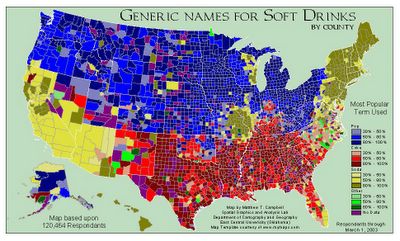
The Great Pop vs. Soda Controversy has a map and explanations, and another map is from the Conglomerate

Tuesday, April 19
I'm surprised I'm not more "General"
Your Linguistic Profile: |
65% General American English |
15% Yankee |
10% Dixie |
10% Upper Midwestern |
0% Midwestern |
Sunday, April 17
China Distorts Its Own History
The above title is what the AP should have given this article rather than the one they gave it: China Accuses Japan of Distorting History By CHRISTOPHER BODEEN
Some things you won't find in Chinese history textbooks:
- China's military attacks on India and Vietnam.
- The 1989 crackdown on democracy demonstrations, when Chinese troops killed hundreds and possibly thousands of unarmed protesters.
- The estimated 30 million Chinese who starved to death during the 1958-61 "Great Leap Forward," revolutionary leader Mao Zedong's attempt to speed up China's farm and factory output through mass collectivization.
- North Korea's invasion of South Korea at the start of the 1950-53 Korean War, a conflict that drew in troops from the United States and other countries on the side of the South and China's army in support of the North.
Experts say China's textbooks are written to heighten a sense of national victimhood and glorify the Communist Party that seized power in a 1949 revolution and lashes out at any threat to its rule.
Chinese Hypocrisy
In Anti-Japan Protests Rooted in Chinese History by Rob Gifford
Anti-Japanese sentiment surged again in China Saturday, as thousands of angry citizens demonstrated against a new Japanese textbook they say glosses over Japan's wartime atrocities. There are Chinese historical precedents for the current wave of protests.The experts note that the demonstrations could get out of control. EastWestNorthSouth offers a compelling argument about the source of the demonstrations:
- The Chinese Communist Party's expertise is in organizing mass movements.
- The Chinese Communist Party is not a monolithic block of steel. Rather, there are various factions which are always struggling against each other.
- Every single mass movement in the history of the Chinese Communist Party was the result of factional fighting. The Anti-Rightist Movement, the One Hundred Flowers Blooming campaign, the Great Leap Forward, the Cultural Revolution, the anti-Lin/anti-Confucius campaign, the 1989 student democracy movement and everything else can be interpreted in that light. A mass movement may have started spontaneously, but it will be instantaneously co-opted for factional fighting or crushed if it suited nobody's purpose. Whenever there is a mass movement, you should look at who is the black hand behind the curtain and what are the motives.
Using these axioms, how might we interpret the events in Beijing and Shanghai over the past two weeks?Cicero
If the whole history of the Chinese Communist Party is about factional fighting, then we should identify the factions of this moment. The two major factions within the Chinese Communist Party right how are the Hu Jintao-Wen Jiabao central government and the Shanghai gang which is centered around former President Jiang Zemin.
can't help but wonder about China's claim of 'moral' supremacy over Japan. While they riot for accuracy in Japanese history books, their own textbooks most likely lack historical exactitude. The 40 million or so Chinese who were killed by Mao probably don't figure in most Chinese history books. And I wonder how they handle China's claim over Tibet? And Tiananmen, 1989? Or Falun Gong? How do they record Mao's disastrous Cultural Revolution now that they're unabashed capitalists?
Obsessing over Japanese history is a good way to keep Chinese citizens from engrossing in their own unfortunate history. Mao's giant portrait still dominates Tienamen Square, the last time I checked. And his successors still speak his name reverently, at least in public. Since the regime appears to be detaching from Mao's murderous legacy while simultaneously claiming legitimacy from his communist system, there's some unfinished historical business, I should think. Perhaps there's a few inaccuracies in Chinese textbooks. Just a few.
More Disappointments from the Heritage Foundation
It's not just that they're pushing intelligent design; it looks like they're just in it for the money.
Think Tank's Ideas Shifted As Malaysia Ties Grew; Business Interests Overlapped Policy By Thomas B. Edsall:
Think Tank's Ideas Shifted As Malaysia Ties Grew; Business Interests Overlapped Policy By Thomas B. Edsall:
For years, the Heritage Foundation sharply criticized the autocratic rule of former Malaysian prime minister Mahathir Mohamad, denouncing his anti-Semitism, his jailing of political opponents and his "anti-free market currency controls."There's more from last year's HK conduit for cash, clout by Matt Miller, who does not include this article on his website.
Then, late in the summer of 2001, the conservative nonprofit Washington think tank began to change its assessment: Heritage financed an Aug. 30-Sept. 4, 2001, trip to Malaysia for three House members and their spouses. Heritage put on briefings for the congressional delegation titled "Malaysia: Standing Up for Democracy" and "U.S. and Malaysia: Ways to Cooperate in Order to Influence Peace and Stability in Southeast Asia."
Heritage's new, pro-Malaysian outlook emerged at the same time a Hong Kong consulting firm co-founded by Edwin J. Feulner, Heritage's president, began representing Malaysian business interests. The for-profit firm, called Belle Haven Consultants, retains Feulner's wife, Linda Feulner, as a "senior adviser." And Belle Haven's chief operating officer, Ken Sheffer, is the former head of Heritage's Asia office and is still on Heritage's payroll as a $75,000-a-year consultant.
Saturday, April 16
Right and Wrong
Daniel Starr's Will You Wait Twenty Years for Your Next Raise?, where he worries about the economy, although he notes
Back in England in the mid-1800s, an amateur economist looked at the historical data and observed, correctly, that the course of English economic growth had somehow made ordinary workers worse off: to take the crudest measure, an English peasant of 1700 could count on getting significantly more to eat than his descendant in 1840. As it happened, just at the time this fellow was writing a book on this apparently inevitable "immiserization" of the working class, things were changing around.I hope Starr's as wrong as that amateur economist, but I hope he's right about this: Taiwan's Secret Weapon Against China: Cameras. Lots of Cameras.
Debate
According to Father Charles Curran,
Catholic Dissidents Call for Openness; John Paul Silenced Many, Critics Say By Alan Cooperman and Daniel Williams:
In the middle of the 19th century, the popes condemned democracy. They claimed that freedom of conscience was a sewer into which all garbage flows. That was in a papal encyclical, those words.His point is not that the Church is evil, but that it can change.
It took the Catholic Church 1900 years to condemn slavery. It was only in the end of the 19th Century that the institution of slavery was condemned.
For 16 centuries, we accepted the fact that you could not take interest on a loan. And this had a strong scriptural basis. It was heavily in the Hebrew Bible. It was in the -- at least the Christian understanding of the New Testament that it said, "Lend, expecting nothing in return."
Catholic Dissidents Call for Openness; John Paul Silenced Many, Critics Say By Alan Cooperman and Daniel Williams:
...dissidents are calling for a new openness and willingness to debate such topics as the ordination of women, condom use to fight HIV/AIDS and the morality of homosexuality.Words and expressions like "openness", "debate", and being "shut out of normal discourse" are a little disengenuous, since they're really talking about changing policies. Not that I'm against it, but after all some people like it the way it is. I still don't see why they don't just start their own church.
Freedom
According to the U.S. Department of State, freedom of conscience
means that no person should be required to profess any religion or other belief against his or her desires. Additionally, no one should be punished or penalized in any way because he or she chooses one religion over another or, indeed, opts for no religion at all.I've got the feeling if certain evangelicals had their way, there would not be so many choices.
It is by the goodness of God that in our country we have those three unspeakably precious things: freedom of speech, freedom of conscience, and the prudence never to practice either of them.
Thursday, April 14
Really?
"Life is not the ultimate public value for most Americans. Law is."
--Jonathan Rauch, on the Schiavo mess.
Subscribe to:
Posts (Atom)