Wednesday, June 16

China spooked by Hong Kong's films By Stefan Hammond:
Despite decades of economic and social reform, the mainland maintains a cinematic nix-list: nudity, homosexuality, extramarital affairs and supernatural themes all remain verboten.

Why is Beijing so concerned about ghosts and goblins? Politically, secret societies based on arcane beliefs have posed threats to China's power structure for centuries. Socially, the shift toward a modern culture has motivated Beijing to create a list of 'approved' religions and conveniently prohibit all else.
I didn't really believe this. Pu Songling's 蒲松齡 Strange Stories from a Chinese Studio 聊斋志异 is considered a major work of literature, but according to Chinese reports, the Chinese authorities (the "Cinema Administrative Bureau" 电影局) have nixed a recent effort to film one of the stories from it: "The Painted Skin" 画皮 (pdf available in Giles' English translation here with Pu's commentary omitted), even though it looked to be a major production, starring Zhang Ziyi 章子怡.


Gweilo Diaries links to this screed from the Commies smearing Anson Chan, including this tidbit:
The deeds of this so-called "Hong Kong conscience", who disregards facts and violates conscience, are like the classic story of Hua Pi in "Strange Tales from a Lonely Studio" - full of evil tricks.
Some old news from June 04: Yu Sen-lun wrote, The government bails out local film industry in Taiwan:
Premier Yu Shyi-kun announced last week the government will provide NT$100 million per film, as a part of a package of policy reform measures to stimulate the ailing film industry.
It's a waste of money.

Meanwhile, Jonathan Ansfield reports Art films repackaged as porn to sell in China:
In "Maiden Work", amateur actors play young bohemian types in post-Mao Beijing. The film self-consciously probes the trials of a lesbian couple and a painter of nudes but, most revealingly, the film makers behind the scenes.

Repackaged, renamed and edited to accentuate the same-sex liaison, the DVD's lurid veneer gives little hint of the raw experiment inside. "Minors under the age of 18 barred from viewing," the cover stresses.

A synopsis on the cover suggests a non-existent love triangle. The movie also has a new title, roughly translating into "Women of desire, body to body".
处女作 sounds sexier in Chinese, where maiden = virgin

Tuesday, June 15

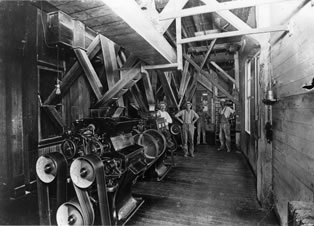
This is from Lucas Jr.'s The Industrial Revolution. Before the dynamo, factories were powered by belts running off of long shafts. Not very efficient. It took some time after the invention of the dynamo to put it to efficient use. How do I know this?
Alex Tabarrok links to Robert E. Lucas Jr.'s The Industrial Revolution and quotes this final paragraph:
Of the tendencies that are harmful to sound economics, the most seductive, and in my opinion the most poisonous, is to focus on questions of distribution. In this very minute, a child is being born to an American family and another child, equally valued by God, is being born to a family in India. The resources of all kinds that will be at the disposal of this new American will be on the order of 15 times the resources available to his Indian brother. This seems to us a terrible wrong, justifying direct corrective action, and perhaps some actions of this kind can and should be taken. But of the vast increase in the well-being of hundreds of millions of people that has occurred in the 200-year course of the industrial revolution to date, virtually none of it can be attributed to the direct redistribution of resources from rich to poor. The potential for improving the lives of poor people by finding different ways of distributing current production is nothing compared to the apparently limitless potential of increasing production.
A Glass Bubble That's Bringing Beijing to a Boil
The building's French architect, Paul Andreu, has come under investigation in France and intense scrutiny in China after a terminal he designed at Charles de Gaulle International Airport in Paris partly collapsed in May, killing four people, two of them Chinese.

His troubles were taken as a green light for China's state-controlled news media and a few leading architects to raise questions about the approval process, the safety standards and the aesthetic sensitivity of Mr. Andreu's Beijing project, which is regarded as a favorite of China's semiretired senior leader, Jiang Zemin.

Beijing's cultural community is also complaining that less than 18 months before the titanium-and-glass complex is scheduled to open, there is no opening act lined up. In fact, no public or private group has agreed to operate the theater at all.

...as billions of dollars of public money are spent on skyscrapers, stadiums and transportation facilities designed by the world's leading architects, local designers are complaining that many of the projects are overpriced and out of touch with Chinese history.
Yes, it's a huge waste, and yes, I'm sure Chinese architects are up to the job, but I cringe at the garishly painted & bracketed pseudo-Manchu stuff that many Chinese seem to find authentically Chinese. I'm not particularly fond of the blue-green-gold-red stuff, even if it is authentic.
JOHN TIERNEY writes, A Nation Divided? Who Says?:
...[D]o Americans really despise the beliefs of half of their fellow citizens?...

To some scholars, the answer is no. They say that our basic differences have actually been shrinking over the past two decades, and that the polarized nation is largely a myth created by people inside the Beltway talking to each another or, more precisely, shouting at each other.

These academics say it's not the voters but the political elite of both parties who have become more narrow-minded and polarized. As Norma Desmond might put it: We're still big. It's the parties that got smaller...

Most voters are still centrists willing to consider a candidate from either party, but they rarely get the chance: It's become difficult for a centrist to be nominated for president or to Congress or the state legislature, said Morris P. Fiorina, a political scientist at Stanford and senior fellow at the Hoover Institution...

The [forthcoming book, Culture War? The Myth of a Polarized America] presents evidence that voters in red and blue America are not far apart. Majorities in both places support stricter gun control as well as the death penalty; they strongly oppose giving blacks preference in hiring while also wanting the government to guarantee that blacks are treated fairly by employers. They're against outlawing abortion completely or allowing it under any circumstances, and their opinions on abortion have been fairly stable for three decades...

Further evidence of a truce comes from Paul DiMaggio, a sociologist at Princeton, and colleagues who have...found that gaps among groups have been constant or shrinking for the past three decades.

"The two big surprises in our research," Professor DiMaggio said, "were the increasing agreement between churchgoing evangelicals and mainline Protestants, even on abortion, and the lack of increasing polarization between African-Americans and whites. Evangelicals have become less doctrinaire and more liberal on issues like gender roles. African-Americans are showing more diversity in straying from the liberal line on issues like government programs that assist minorities."..

Why, if the public is tolerant, would the political elites be so angry? One reason given by Professor Fiorina is the decline of party bosses, who promoted centrist candidates because their patronage systems depended on winning elections, and the corresponding rise of special-interest groups, who are more concerned with candidates' ideology.

Losing an election doesn't put pro-life or gun-control advocates out of work - in fact, it can help raise money for the cause. Nor does it hurt broadcast ratings or book sales for polarizing media figures like Sean Hannity and Al Franken, who need battles to keep their audiences entertained.

Another reason is gerrymandering, which has created so many safe seats that the only threat to incumbents comes from within the party, forcing them to appeal to the partisan voters who dominate primaries...

...when it comes to Bush...Professor Fiorina insists the voters are merely responding to a president who is more partisan than virtually all of his modern predecessors.


Meanwhile, in Stuck in Purple America, Ilya Shapiro writes,
Purple America is not so much a place as an idea, or more precisely a confluence of values from Red America with tastes from Blue America. It believes in personal responsibility, discipline, civil society, spontaneous order, ordered liberty, and that the best thing government can do is not get in the way. Yet it craves independent films, fine cigars, Belgian ales, and South American fútbol -- along with a good baseball game (preferably without the designated hitter).
I actually don't agree with many of the specifics, but still, I guess I'm purple.

Saturday, June 12

India gains on China among multinationals. The article points out how in India Whirlpool manufactures for the local market, while in China it manufactures for export. So naturally it prefers India. Meanwhile, No-frills cars gain fans in China:
Chinese-owned carmakers such as Geely and Chery Automobile are grabbing sales from overseas rivals by undercutting their prices and, Honda Motor and Toyota Motor allege, stealing their designs and technology. The government said last week in an auto-industry policy statement that it wanted local carmakers to become globally known brands.

Models from Geely, China's biggest privately owned domestic automaker, and the state-owned Chery are making it harder for General Motors and other international automakers - which use more imported parts than their local rivals - to sell cars in a country where annual urban incomes average $1,000.
Protests now flourish in China
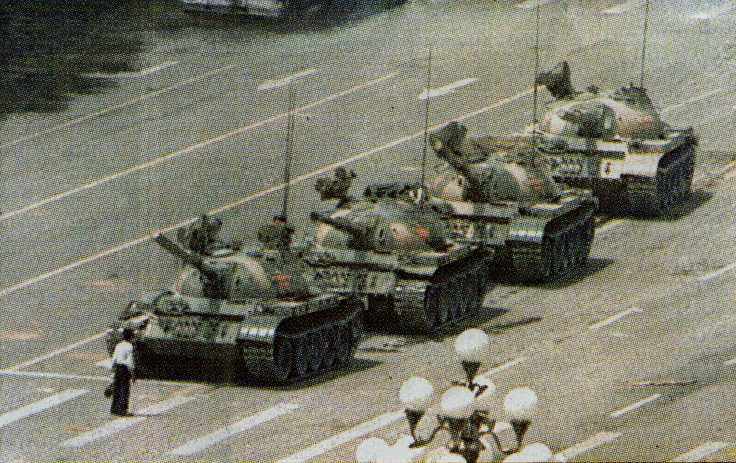
On the 15th anniversary of China's suppression of student protesters in Tiananmen Square on June 4, 1989, few in the West seem aware that Beijing is again confronting a growing volume of popular protest. Even more surprising, reports of this widespread protest are being confirmed by China's own police forces, which used to routinely deny permission for most protest demonstrations.

Recent official police statistics are striking. The number of demonstrations increased from 8,700 to 32,000 from 1993 to 1999 - an increase of 268 percent. The number probably swelled past 40,000 in 2000. In no year during this period did protests increase by less than 9 percent, and in the financial crisis years of 1997 and 1998 they spiked by 25 and 67 percent, respectively.

Though we lack nationwide data for the years since 2000, Chinese government reports indicate that the number of public protests has probably risen each of the last three years. Sichuan, China's largest province, apparently saw an increase in protests of almost 20 percent last year, to nearly 1,500.

No region has experienced more demonstrations than the aging northeastern rustbelt, known to the West as Manchuria, where market reforms have badly hurt workers and pensioners from inefficient state enterprises. Police in Liaoning Province on the border with North Korea claimed a stunning 9,559 incidents involving more than 863,000 people between January 2000 and September 2002 - an average of almost 10 incidents involving 90 people each day for nearly three years.

Yet, save for occasional high-profile outbursts such as the worker protests in the northeast in the summer of 2002 or pro-democracy protests in Hong Kong, we hear little about unrest. Undoubtedly, a key reason is that today's protesters lack the telegenic grip of those brave young hunger strikers
of 1989.

For China's stability, a greater concern than these raw numbers is the changing style of protest. Police concede that demonstrators are gradually outgrowing the deliberately small-scale, self-contained tactics they adopted in the 1990s to avoid repression. Protests are expanding in average size, becoming more organized and confrontational, and increasingly link demonstrators from several workplaces or neighborhoods. Clever tacticians, protesters now routinely place retirees, women and children in the front ranks to shame factory managers and paralyze police.
Yeah, well, good luck with that.
Marriage in China:
As much as weddings in China have changed, so too has marriage itself. Gay union may still be out, but looser attitudes towards sex, marriage and divorce have led to a more colourful national love life. As late as 1989, six out of seven newly married couples would not have had sex before the paperwork was complete. Now, as many as 70% of young adults in urban areas have indulged. These numbers, according to Li Yinhe, of the Chinese Academy of Social Sciences, reveal the arrival of a sexual revolution that was long overdue. Ms Li also reckons that the rise in the divorce rate--from 3% in the 1970s to 14% today--is a healthy development, indicating that unhappy couples are no longer discouraged from divorcing in the interest of "stability".
World cup is not about football but is from Madeline Drexler's review of The Empire of Tea: The Remarkable History of the Plant That Took Over the World by Alan Macfarlane and Iris Macfarlane and Tea: Addiction, Exploitation, and Empire by Roy Moxham. She writes,
Tea is the most commonly consumed beverage on earth, after water -- and that's just a minor entry in its lengthy and truly mind-boggling resumé. Long before it started slumming in dunkable filter-paper bags, the "fragrant leaf" had inspired Ming Dynasty porcelain; cut death rates from waterborne infections; braced British colonial expansion; ignited the Opium War; necessitated the wondrous designs of 19th-century clipper ships; and energized the Industrial Revolution. More recently, of course, tea has earned renown as a rich source of health-bestowing antioxidants.
So it must be true. Except Chinese started to make porcelain for tea in the Song dynasty. So are they saying that Ming-style porcelain was made for tea?
I emailed this criticism of Michael Moore by Andrew Anthony to my father, who responded,
The article about Michael Moore was pretty bad. The columnist was most supercilious and snide.
Funny, I've always found Moore's the one that's supercilious and snide (which I take to mean slyly disparaging rather than dishonest, but that would fit, too; or did he mean unworthy of esteem?).

Friday, June 4

Happy June 4th! Let's hope the Chinese Communist Party doesn't kill many more people!

Thursday, June 3

This is supposed to be Yang Guifei 杨贵妃 at the Huaqing Pool 华清池(from which she is supposed to have emerged sexily flushed). The thing is, she's supposed to be fat.
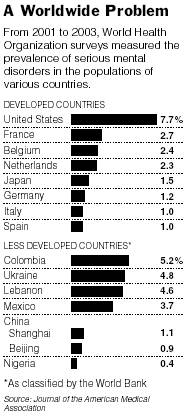
According to DONALD G. McNEIL Jr.'s citation of Dr. Ronald C. Kessler in the New York Times' Large Study on Mental Illness Finds Global Prevalence:"In China, for instance, no word distinguishes depression from sadness". Someone's got it wrong. In both China and Taiwan, the word for depression is youyuzheng 忧郁症 (憂鬱症; don't you love those 繁體字?). In fact, unlike its English equivalent, the final "zheng" indicates that this is a disease; one could argue that in English, to the layperson "depression" is not so obviously a disease.

Otherwise, the study--based on face-to-face interviews--shows the prevalence of mental illness in urban China as being exceedingly low; around 1%; in the US it's 7.7%, far more than other developed countries. So either Americans are crazy, or we're more willing to admit it, or one could say, blame it for our problems.

Of course the WHO doesn't include Taiwan. Maybe they're all nuts here. Posted by Hello

Wednesday, June 2

In response to this talk about female bloggers at Dan Drezner, via Is blog a masculine noun?, I find a post at Karmalised about what Bill Cosby said. I've never heard of it; so all those white bloggers I read don't seem so eager to take it up as a way to whip the black man. Clarence Page's interpretation makes sense to me.
FRANK RICH writes in It Was the Porn That Made Them Do It that
Some of our self-appointed moral leaders want to...blame Janet Jackson for what's gone wrong in Iraq, or if not her, then Jenna Jameson...

If porn or MTV or Howard Stern can be said to have induced a "few bad apples" in one prison to misbehave, then everyone else in the chain of command, from the commander-in-chief down, is off the hook. If the culture war can be cross-wired with the actual war, then the buck will stop not at the Pentagon or the White House but at the Paris Hilton video, or "Mean Girls," or maybe "Queer Eye for the Straight Guy."

The hypocrisy of those pushing this line knows few bounds. They choose to ignore the reality that the most popular images of sadomasochism in American pop culture this year have been those in "The Passion of the Christ," an R-rated "religious" movie that many Americans took their children to see, at times with clerical blessings. Mel Gibson's relentlessly violent, distinctly American take on Jesus' martyrdom is a more exact fit for what's been acted out in Abu Ghraib than the flouncings of any cheesy porn-video dominatrix.
According to him, in essence, those who blame porn are trying to devolve the Bush administation of all responsibility.

Although Rich makes no reference to it, the editor has added a photo with the caption "A historical antecedent of the photos from Abu Ghraib: The 1930 lynching of Thomas Shipp and Abram Smith in Marion, Ind."

That's something taken up by Susan J. Brison in Torture, or 'Good Old American Pornography'? She writes,
...the similarities between American-style torture and hard-core porn are difficult not to notice and, given our tolerant, even self-congratulatory, attitude toward pornography, why should we be so shocked when torture takes this form?

...we -- and the rest of the world -- are also bothered by the fact that the U.S. soldiers in the pictures (and presumably those taking the pictures) clearly got a kick out of what they were doing. In this respect, these photos resemble the postcards circulating in the United States in the early 20th century showing white people smiling and cheering at the lynchings of black men (and sometimes women) -- the photos that showed us that racial animus can amount to a kind of giddy arousal. What revolts us now is not just that black men were lynched, not just that white spectators on the scene were smiling and laughing at the murders of their fellow human beings, but that the people sending the postcards could assume (and rightly so) that their recipients would also get a charge out of the images.

But we must not confuse reality with representation. Each of the black men depicted in the postcards was actually lynched -- and none of them consented to be. In contrast, the Asian women who posed naked, bound with heavy rope, and hung from trees for a 1984 Penthouse series of photos of eroticized torture presumably consented to (and were financially compensated for) their treatment and its photographic documentation. Besides, those photos, unlike the lynching postcards, were intended to give men sexual pleasure. And we all know, post-Freud, that people's imaginations are filled with all sorts of unfathomable erotic imagery and that we should be wary of suppressing the external representation of such fascinating and perplexing interior landscapes. But the lynchings of black men in the South also had a sexual component; not only did they often involve castration, but the kind of kick some white folks got out of the lynchings (and their depictions) strikes me as not all that different from a form of sexual arousal. I'm sure some white racists' fantastical interior landscapes still include trees with such strange fruit, but that would not be taken to provide sufficient reason for the rest of us to tolerate the widespread production and sale of such images.

...a disturbing amount of hard-core porn produced in the West is based on the view that violently degrading others is arousing, and we need to begin to question the assumption that whatever some people find arousing should be tolerated by the rest of us.
(emphasis mine) So whereas for Rich blaming porn is wrong, for Brison it's absolutely right. But to blame porn she not only has to drag in lynchings of blacks, omitting to explain that the soldiers in Iraq are in a quasi-combat situation; to compare them to blacks is to paint the soldiers as racist and to forget that their victims are the enemy. If we go along with her and say, yes, the soldiers are racist, and yes, the victims of their torture are all innocent, then we get to say that there is no such thing as an enemy in Iraq. She also has to find a sexual element in lynching. It makes you wonder if there is anything that's not sexualized for her. Finally, with the internet, how does this self-appointed moral leader propose to be intolerant about "the widespread production and sale of such images"?

Like this Nini 妮妮, who's got an adult site, and claims to be a student at Chinese Culture University 文化大學, so the authorities are concerned about the site being harmful to society's morals 妨害風化. How do they propose to shut it down?

Exposed: conman's role in prayer-power IVF 'miracle'
It was a miracle that created headlines around the world. Doctors at one of the world's top medical schools claimed to have scientifically proved the power of prayer...

One of the study's authors is a conman obsessed with the paranormal who has admitted to a multi-million-dollar scam. Daniel Wirth, now under house arrest in California awaiting sentencing, has used a series of false identities for several decades, including that of a dead child...

Many scientists are now questioning how someone with Wirth's background was able to persuade Columbia University Medical Centre to unveil his research in such a high-profile way. They also want to know why it appeared in the respected Journal of Reproductive Medicine, whose vetting procedures are usually strict. 'We are concerned this study could be totally fraudulent. It is an amazing saga,' said Dr Bruce Flamm, a clinical professor at the University of California.
Yeah, well, sooner or later any crap can get published. Speaking of making things up, there's also this: Boy, 14, 'posed as spy to arrange his own murder'
A schoolboy posed as a female British secret service spy in an internet chatroom to persuade a friend to try to murder him, a court heard yesterday.

The boy, John, now 15, groomed a 16-year-old boy, Mark (both pseudonyms to protect the children), with an "elaborate matrix of deceit" involving six fictional characters in the MSN chatroom and correspondence totalling 56,000 lines of text.

The fictions created by John, then 14, convinced Mark that he was murdering someone who had a terminal brain tumour. He was told that his reward would be money, a job as a British secret service agent and sex with the spy, whom he believed was a middle-aged woman.

In fact, John was determined to get himself killed, which is why he never used the abort code - 6969 - that he provided.

Manchester Crown Court heard that John, who had fallen in love with Mark, also tricked him into performing sex acts on a webcam before tricking him into stabbing him twice in an alleyway at Altrincham on 29 June last year. Though John's life was in the balance for a time, he did not die and was released from hospital after a week.
Hit and Run's link omits the homosexual aspect.
Cathy Young in Reason
White panelists talking to a mostly white audience about the need for the black community to fix its problems risk coming across as offensively patronizing. But the message of responsibility was most powerfully articulated by a black speaker, Vanderbilt University law professor Carol Swain.

Swain identified a number of cultural factors that may hold black students back, including 'dysfunctional abusive homes,' 'lack of parental involvement in the schools,' and 'negative peer pressure about learning and about high achievement as evidence of one's 'acting white.'' Better schools may provide some solutions, Swain said, but there must also be cultural change, and 'middle-class minorities must take a leadership role in this area.' On an even more controversial note, Swain identified affirmative action as currently practiced by universities--lower admissions standards for blacks and Hispanics--as part of the problem. These policies, she said, have 'created a negative incentive structure for African-Americans who have either internalized societal messages about inferiority or have chosen an easier path of not exerting themselves too vigorously' since they don't have to meet higher standards.
Ouch.

Tuesday, June 1

This Anti-drip law drives me crazy.
Starting June 1, the Cabinet-level Environmental Protection Administration (EPA) will use Article 27 and Article 50 of the Waste Disposal Act (廢棄物清理法) to impose fines of between NT$1,200 and NT$6,000 on violators if their air conditioners are found to drip water, which is deemed as pollution.
Meanwhile, particularly in Kaohsiung, you can't drink the water, you can hardly walk down a sidewalk or under a qilou 騎樓 (pedestrian arcade) because of the parked cars and motorcycles or other miscellaneous junk, not to mention the ones that are driving there, or the danger in crossing the street. As far as Taiwan's dangerous traffic is concerned,
Taiwan's rate of accidental deaths is far higher than other developed countries, except South Korea, according to the most recent report by the WHO in 1996.

Monday, May 31

Anti-Globalism = Anti-Americanism By Jean-Francois Revel
The enfeebling of the Europeans’ position in the world is self-caused: They alone are responsible for their own heaped-up aberrations and follies over the first half of the past century. This weakening entailed the corresponding and virtually automatic rise of the United States.

Strikingly, Americans continue to increase their lead, even since the consolidation of the European Union. That a united Europe hasn’t yet risen to the challenge is obviously not for lack of material and human resources, but rather for lack of understanding of how to use them. Inhibited by ideological prejudices, Europe, despite her successes, continues to live overshadowed by America. Witness the fact that the health of her economy is dependent on the state of America’s economy: Whenever the latter goes into recession, as in the beginning of 2001, Europe falters.

Elsewhere, American-style market capitalism is equally successful and dominant. Third World countries have developed at sharply different rates basically according to the degree to which they have respected free markets, and left economic activity to private enterprise rather than to undertakings of the state. Even in nations like China where political communism has artificially prolonged its existence, it has done so only by thoroughly expunging economic socialism through privatization, appeals to foreign investors, deregulation of commerce, and establishment of cross-border trade agreements. Only Cuba and North Korea have clung to economic collectivism, with utterly disastrous results...

Resentments that lead to the rejection of every idea that comes from America simply because it is American can only weaken countries. To follow such a course is to let phobias become guiding principles. Does anyone really believe today that nations which substitute government edicts for economic markets are likelier to prosper? Must we close our eyes to the achievements of the last 50 years of increasing economic liberty, when worldwide production grew by a factor of six and the volume of exports by a factor of 17? Must investment capitalism abroad, the engine of extraordinary, racing progress for many previously poor countries, be banned just because it often brings links to America?

We French have had little to say against Saddam Hussein, Muammar Qaddafi, Kim Jong Il, Fidel Castro, Robert Mugabe, the imams of the Islamic Republic of Iran, or the bosses of China and Vietnam. We reserve our admonitions and our contempt and our attacks for the U.S., for Ronald Reagan and George W. Bush, and for Europeans like Margaret Thatcher, Silvio Berlusconi, and Tony Blair, because they are insufficiently hostile to capitalism. Our enemy is not the dictator but the free market economy.

Anti-globalizers make the same mistake. What’s important to them is not the eradication of poverty. Rather, it is the propaganda value they gain from linking poverty to the spreading market economy. But this puts them on the wrong side of all evidence, of reality, of history.

Life expectancy in Third World countries has more than doubled during the free-market dominated second half of the twentieth century. In India, food production has grown by a factor of ten, leading to the elimination of massive famines. In Latin America, per capita income doubled between 1950 and 1985. Over the past 50 years, Latin America on the whole has experienced an annual growth of 5 percent. No European country can boast an equivalent rate. These figures show to what an extent the mantras about ever-increasing poverty spring from ignorance or simple dishonesty. Where poverty continues to exist today it is almost wholly due to ruinously inefficient public sectors.

This is most obvious in Africa, the only Third World continent to have actually declined. Impoverishment there has political, not economic, causes. It is statism, not the market, and socialism, not capitalism, that has destroyed the African economies. After independence, the African elites who formed the political leadership generally adopted the Soviet and Chinese systems. Thus they were able to assume absolute power with access to the levers of personal enrichment. And from communism they borrowed an infallible recipe for agricultural ruin: collectivizing the land, from Algeria to Tanzania, setting up “cooperatives” that quickly became unproductive.

In these fatal mistakes the Third World has had false friends. In particular, the privileged pseudo-revolutionaries of Seattle and Göteborg have encouraged them down the primrose path of anti-capitalism. Lacking any real knowledge about the African cataclysm, and careless about finding remedies, the anti-globalist agitators prefer hurling brickbats at their perennial hobgoblin to the moral imperative of saving and improving lives.
And here's something else on Africa from Anthony Daniels' review of Robert Guest's The Shackled Continent: Africa's Past, Present and Future:
For many years, the whole purpose of education in Africa, from the pupil's and student's point of view, has been to obtain a position in government from which to extort and expropriate from others. "Seek ye first the political kingdom", said Kwame Nkrumah, and that is precisely what Africans have been doing ever since, with disastrous results.

The more African bureaucrats and politicians extort and expropriate, the less there is to extort and expropriate, which makes the competition for power ever more desperate and violent. And the wholly parasitic nature of the elite explains why both the expansion of education and the existence of natural resources in an African country conduce not to prosperity, but to civil war and impoverishment.