Friday, June 3
Creepy
Being a Single Mother -- and Very Young and expressing no regret about a "poor life choice", but instead whine about how she's got to be able to go out and have time for herself.


Personal Finance in the Curriculum
Georgia Schools to Focus on Personal Finance by Emily Kopp
School officials in Georgia have decided they're going to try to cut the state's high rate of personal bankruptcy. And they'll be starting with kindergarten students. Emily Kopp of Georgia Public Broadcasting reports that the state's Board of Education is making personal finance a key part of school curriculum.The report mentions The National Council on Economic Education as a supporter. This sounds like a great idea to me.
Slanted
White House Plays Hardball with Critics makes zero mention of "the gulag of our times".
(I listened to it with Real Alternative, which worked nicely)
Meanwhile, IRFAN HUSAIN writes Rights issues: Are Muslim countries any better?
(I listened to it with Real Alternative, which worked nicely)
Meanwhile, IRFAN HUSAIN writes Rights issues: Are Muslim countries any better?
A recent Amnesty International report on human rights abuses in American detention centres is devastating in its forthright criticism. Irene Khan, the director of the organisation, has lambasted the American military for running what she calls the ‘gulag for our times’. Her American colleague points out that the use of torture has lowered Washington’s moral authority in dealing with other violators of human rights around the world.
But there is a note of hypocrisy in some of the criticism emanating from the Muslim world. For instance, the Gulf News in its leader of May 22 thunders: 'All prisoners must have rights, wherever they are held, for whatever reason...'
This forthright demand will come as scant comfort for the thousands of prisoners routinely beaten and tortured from Turkey to Indonesia.
Of course American abuse of prisoners must be condemned by all of us. But at the same time, we need to take a hard look at what’s happening in our prisons. In its annual report for 2004, this is what Amnesty International says about Pakistan’s track record: 'Torture and ill-treatment by the police and prison officers remained routine and the perpetrators were rarely held to account. Several people died in custody.'
The report does not mention the role of our intelligence agencies in torturing suspects. However, from time to time, their hand is exposed. Recently, two Americans of Pakistani origin were released after eight months of illegal detention, and accused the Pakistani authorities of subjecting them to torture with FBI complicity.
Commenting on this case, the Asia director of Human Rights Watch, spoke of 'Pakistan’s dreadful record on illegal detentions and torture...'
Indeed, over the years, Amnesty International, Human Rights Watch and other similar organisations have been compiling a woeful record of abuses in Pakistan as well as in other Muslim countries. It is precisely for this reason that Americans have been flying suspected terrorists to various Muslim nations in a process known as ‘rendering’. In order to avoid breaking their own laws, US agencies ‘outsource’ torture to friendly Muslim states where prisoners, contrary to the Gulf News’ editorial quoted earlier, have no rights.
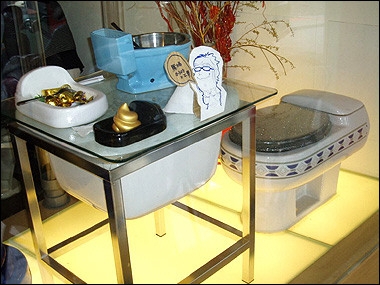
馬桶餐廳
Also known as the Marton Theme Restaurant. Via yahoo, the outside:
The inside:
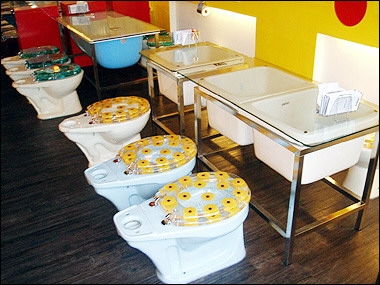
As this article says, restaurants here are often gimmicky. Worse, the food usually has little to recommend it. It's been a long time since I've had a decent meal here in Kaohsiung. Meanwhile, everyone seems to want to eat hotpot. Ugh. A few days ago we ate different kinds of noodles/spaghetti at 緣園茶餐廳 Destiny Tea Restaurant, which was overpriced crap. I'd give it as even lower ranking than this.

The inside:
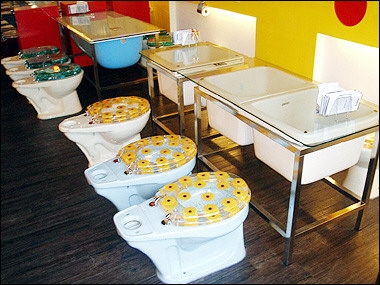
As this article says, restaurants here are often gimmicky. Worse, the food usually has little to recommend it. It's been a long time since I've had a decent meal here in Kaohsiung. Meanwhile, everyone seems to want to eat hotpot. Ugh. A few days ago we ate different kinds of noodles/spaghetti at 緣園茶餐廳 Destiny Tea Restaurant, which was overpriced crap. I'd give it as even lower ranking than this.
Taiwan Taxes
Not surprisingly, the pro-DPP Taiwan News supports Chen's mooted tax increase. Similarly, according to a Taiwan government web site,
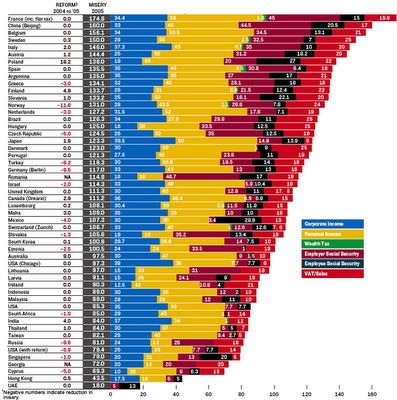
(click for larger pic)
...the president said that the government needed to press harder to realize fiscal reform in order to promote social fairness and justice, improve government finances and promote economic development.The pro-DPP Taipei Times's Tax-reform plan sparks heated debate By Jackie Lin
Chen said that Taiwan's national taxation rate is "too low" when compared to the average of 27 percent in the member countries of the Organization of Economic Cooperation and Development...
In his successful campaign for the March 2000 presidential election, Chen followed the advice of tax scholars and floated the proposal for the revival of the securities transaction income tax, but backed away from the suggestion after intense media criticism and anger from individual investors.
The national taxation rate is a gauge of a nation's tax burden divided by its GDP. Taiwan's tax requirements pale in comparison to those of members of the Organization for Economic Cooperation and Development (OECD), whose national taxation rate is about 27 percent.Meanwhile the pro-KMT China Post cites Liu at more length:
...Chen said the value-added tax should be raised in the near future by 2 to 1 percentage points from the current 5 percent, a minimum tax scheme should be imposed and inheritance and gift taxes should be trimmed from 50 to 40 percent to boost investment.
These measures, however, have been widely criticized as robbing the poor and giving to the rich. Increasing the value-added tax rates would be reflected in commodity prices, so this is seen as a hidden tax on the general public.
Although the prices of some products might be hiked after the new regulation is put in practice next year, manufacturers' tax costs may not be entirely transferred to consumers due to fierce competition, the Ministry of Finance said.
Furthermore, daily necessities such as fresh food, agricultural products and rice are exempt from value-added taxes and won't be affected by the new measure, the ministry said.
However, People First Party Legislator Christina Liu (劉憶如) said levying a value-added tax across all kinds of products does not conform to social justice.
She suggested that luxury goods be charged a higher tax, and that consumer products that are used on a daily basis, such as medicine, should be free from the tax.
Christina Y. Liu, a second-term PFP lawmaker, said the president simply cannot increase tax on the one hand and continue to borrow on the other.Of course, if the KMT were making the proposals, the show would be on the other foot. Anyway, Forbes believes that low taxes are good, and there is no reason to raise them; see their Tax Misery & Reform Index
She referred to a US$18 billion arms purchase from the United States, which will be financed by the borrowed money.
Moreover, Liu said, the government can easily raise the tax revenue by NT$30 billion or NT$40 billion, if the economy is kept growing by two percent a year.
"There's no need whatsoever for the government to increase tax," said Liu, who used to teach finance at a university.

(click for larger pic)
Thursday, June 2
Progress is Taking Someone Else's Money
Tax Breaks for Rich Murderers is David Runciman's review of Death by a Thousand Cuts: The Fight over Taxing Inherited Wealth by Michael Graetz and Ian Shapiro
Anyway, according to Brian Doherty's Death and Taxes, a fairly ancient article,
[T]he politics of another country’s tax system is unlikely to be of much interest to anyone with any sort of normal life... Don’t let that put you off. This is one of the most interesting books about politics, and power, and the way the world is going, that you are ever likely to read.I'm in no danger of being personally affected by the estate tax, but I just don't get why it's assumed that it's absolutely OK to take money away from the rich. In fact Runciman does seem to get it:
...The estate tax was the most progressive part of the American tax system, because it rested on the principle that the wealthy few, if they were not willing to bequeath their money to charity, should not be permitted to pass it all directly to their heirs. It had been on the statute book for nearly a hundred years, and throughout that time it had been generally assumed that there was widespread support for the idea that unearned wealth passed between the generations, creating pockets of aristocratic privilege, was not part of the American dream. [I]t was a tax that so obviously took from the relatively few to relieve the burden on the very many....
As Graetz and Shapiro point out, the politics of taxation in the United States has traditionally relied on a relatively straightforward choice. Policies that allow individuals to hold onto their money and do with it what they like may be economically efficient, but they are not particularly fair: many people will end up with less than they need and perhaps than they deserve. Progressive taxes, which are more equitable, are nevertheless not so efficient at generating future wealth...So he's unapologetically opposed to economic efficiency and the generation of future wealth, and there's one minority it's OK to mistreat; he cites Grover Norquist
[i]n an exchange on National Public Radio, the transcript of which is included in this book and is practically worth the price of admission on its own, Norquist went a stage further:Note that it's lunacy to criticize class warfare.I think it speaks very much to the health of the nation that 70-plus per cent of Americans want to abolish the death tax, because they see it as fundamentally unjust. The argument that some who play the politics of hate and envy and class division will say, ‘Yes, well, that’s only 2 per cent,’ or, as people get richer, 5 per cent in the near future of Americans likely to have to pay that tax. I mean, that’s the morality of the Holocaust. ‘Well, it’s only a small percentage,’ you know. ‘I mean, it’s not you, it’s somebody else.’
After a bit more of this, Norquist’s interviewer, Terry Gross, feels compelled to intervene: ‘Excuse me. Excuse me one second. Did you just . . . compare the estate tax with the Holocaust?’ Norquist starts to backtrack, but he doesn’t get very far:
You might expect this to have been the point at which the repeal movement started to fall apart, given that the pro-repeal lobbyists were trying to recruit support from all areas of American society, not just the lunatic fringe...No, the morality that says it’s OK to do something to a group because they’re a small percentage of the population is the morality that says the Holocaust is OK because they didn’t target everybody, just a small percentage . . . And arguing that it’s OK to loot some group . . . or kill some group because it’s them and because it’s a small number, that has no place in a democratic society that treats people equally . . . When South Africa divided people by race, that was wrong. When East Germany divided them by income and class, that was wrong. East Germany was not an improvement over South Africa.
...Once the estate tax had been depicted as a form of 'discrimination', and voters reminded that successful gay and lesbian couples were already discriminated against by not being free to take advantage of marital tax deductions, polls discovered that 82 per cent of gays and lesbians were in favour of estate tax repeal, even though the vast majority were also supporters of Al Gore."Social solidarity between the wealthy few and the disadvantaged many" means taking away from the former to give to the latter. That's not so much solidarity as making everyone the same in terms of income.
The only way this strategy could work, of course, was for the estate tax to be viewed in complete isolation from any wider questions of social solidarity between the wealthy few and the disadvantaged many, within and across various minorities.
Part of the problem for the Democratic Party was that their enemies seemed to have all the best stories when it came to the estate tax: all those tales of hard-working families striving to make their way in the world, until the grim reaper conspires with the taxman to scatter their modest fortunes to the winds. But were there really no stories to throw back? Graetz and Shapiro suggest that a similar campaign could have been run by the opponents of repeal, highlighting a few of the many instances of wholly worthless individuals inheriting a large chunk of unearned wealth on no basis other than an accident of birth. It has to be said, however, that the way Graetz and Shapiro lay out this option is indicative more of the problems liberals have with confronting the dark arts of their opponents than it is of any likely solutions. They identify Paris Hilton and Nicole Richie, stars of The Simple Life...as possible poster-children for the absurd injustice of inherited wealth...And here I thought the class warfare types had all the best stories.
It would be better, surely, to adopt a strategy that Graetz and Shapiro rule out as much too extreme, which is to find some examples of well-known criminals who came into a stack of money, like Michael Skakel (the Kennedy cousin who was convicted of murdering Martha Moxley), and run with the slogan: 'Bush favours tax breaks for rich murderers.'...
Anyway, according to Brian Doherty's Death and Taxes, a fairly ancient article,
The tax hits mostly family-owned businesses, 87 percent of which don't survive to a third generation. (Nearly 90 percent of estate taxes are paid on estates worth less than $2.5 million.) The Small Business Survival Committee estimates that 90 percent of family businesses that fail right after the founder dies do so because the business doesn't have enough liquid cash to pay the estate taxes. In a 1993 study, Richard Wagner, chairman of George Mason University's economics department, estimated that estate taxes have cost 262,000 jobs since 1971.
Which means that even the feds aren't getting their money's worth from estate taxes -- which amount to less than 1 percent of the budget, generally less than $15 billion a year. With the income taxes lost due to stifled job creation and money spent on estate planning, plus enforcement and compliance costs that can be higher than 50 cents on the dollar, even that small federal benefit might be an exaggeration.
Wednesday, June 1

Options
On one of my computers but not the other, when I click on the little "Options" triangle on the lower right of the toolbar, I get this pop-up, with one of the options "corrections"--I have no idea what that does.


Tuesday, May 31
Baby Ruth
One day in the bottom of the pool back home in the US, I saw something on the bottom of the pool that looked like a dog biscuit or a turd and told the lifeguard after completing my swim. I never found out what it was. Maybe I should have told him earlier, but then we'd all have to get out:
...the visit was blissfully uneventful until a floater was found in the water during the 3:15 "safety break."Go here for the rest of the Baby Ruth saga.
Everybody got out of the water, except of course for the floater, which bobbed brown and serene, near the lap lanes. The teenage lifeguards stood in a semi-circle at the edge of the pool, their bare feet twisting uncomfortably, their faces tragedy masks of oppression.
Roofed Pool
Speaking of swimming pools, 前鎮游泳池 has been roofed over now for a couple of years. 前金游泳池, which never was roofed over, closed when it rained, but Qianzhen was open today even as it rained. That's progress. The other thing the roof does is to keep the water cooler, which is fine with me. That may keep out those annoying water aerobics people. On the other hand, they don't put up the ropes at Qianzhen. And the men's clothes-changing cubicles have neither hooks nor curtains, making them pretty useless, while the individual shower cubicles have curtains but no hooks placed where one can keep one's things.
Spoon
Every pool I've been to in Taiwan and in Paris has clothes-changing cubicles, which is odd, since in the US locker rooms we can see each others' shrinky-dinks. Aren't Americans supposed to be individualists and the other guys collectivists? Meanwhile, our locker rooms are segregated by sex. I assumed the rationale is so we don't ogle the opposite sex, although my wife tells me that I'd want to gouge my eyes out after seeing most of the women in her locker room. Anyway, if the rationale is against oging, what if a gay guy looks at me carnally? Doesn't that mean they should have separate locker rooms for gays? But what if a gay guy looks at another gay guy carnally?! So for the sake of consistency we should either have individual changing rooms, or just one big locker room where everyone lets it all hang out. And maybe they should have a spoon for gouging out one's eyes.
High Conviction Rates
According to Travellers' Tales
If you were falsely accused of a crime, would you prefer the trial be held in:But there are no citations. In Why Is the Japanese Conviction Rate So High? J Mark Ramseyer and Eric Rasmusen say "...the high conviction rates reflect case selection and low prosecutorial budgets; understaffed prosecutors present judges with only the most obviously guilty defendants."
A. China
B. South Korea, or
C. Japan
Give up? The correct answer is D. None of the above.
That's because in all three countries, the conviction rate is 99%.
Nobility in Every Profession
Are you proud of your job? By Del Jones lists the professions with the top prestige. How one feels about one's own work also matters. As the article says,
...the most satisfied workers were those who felt they had a positive impact on others, to the point that many firefighters wished they could fight more fires.
Marcus Buckingham is author of The One Thing You Need to Know and an expert on employee satisfaction and productivity, known as employee "engagement." He says there are plenty of engaged workers doing the most menial work. He learned that years ago when he studied the best hotel maids at the Walt Disney resorts. Likewise, some of the most disengaged people he has encountered are those at the very top of companies.
There is nobility in every profession....
Chirac
Amongst all the reasons that the French ought to have voted "yes" was the desire to create a "multipolar" world, that is, one not dominated by the American "hyperpower". But French disgust with their current domestic economic problems seems to have trumped that. How much of it was Chirac's fault? Plenty of people have a low opinion of him: "Chirac, the tired old dinosaur who seems increasingly uncomprehending of today's world...." Peter Preston writes,
The great French referendum debacle is much more than wriggling humiliation in the Maastricht manner. It writes the obituary of a presidency which doesn't deserve to survive. Jacques Chirac's performance, from start to finish, has been inert and empty. Who could trust a single word he uttered?And David Ignatius blames Chirac's Failure To Lead
France's stunning rejection Sunday of a new European constitution was, most of all, a noisy protest against the disruptive, leveling force of economic globalization. You could see that in television images of the "no" voters as the result was announced -- burly arms raised in the air, fists cocked -- as if by rejecting a set of technical amendments to European rules they could hold back a threatening future.
And you could see the result on the faces of the losers -- glum establishment politicians being interviewed after the vote, trying to put a brave spin on a devastating defeat. For this no vote had been opposed by nearly all the luminaries of the French political class in both the socialist and conservative parties.
It was a no that resonated on many levels: a rejection of the document and the wider Europe it came to symbolize, a rejection of a market-driven way of life that's taken for granted in America, and above all a rejection of President Jacques Chirac, who tried to trick and cajole France into embracing the realities of the global economy, rather than forthrightly explaining them.
Fear of the future is always a powerful political force, and one that often has unfortunate consequences. And it's hard in this case to see much positive coming out of the French no. Europe will go on as before, but European politicians will be tempted to waste even more time soft-pedaling the fact of global competition rather than helping their people adapt and change.
Chirac will be a chief victim of Sunday's vote, and he richly deserves the scorn that will be shoveled his way. His mistake was far larger than what commentators were citing Sunday night: his decision to put the constitution to a vote even though that wasn't technically necessary. Chirac's real failure was his inability over two terms as president to level with the French people about the changes that are needed to protect the way of life they cherish. He played games with economic reform -- tiptoeing up to the edge and then pulling back at any sign of public displeasure.
Living in France for four years, I came to appreciate what a wonderful country it is, with a quality of life that is truly the envy of the world. Not surprisingly, it is also an intensely conservative country, for all its reputation for liberality. Whatever their class, age or political orientation, French people want to conserve what they've got. They want to maintain inflexible management and labor unions, six-week vacations, a 35-hour workweek -- and also to be a growing, dynamic, entrepreneurial economy. Chirac never had the guts to tell the French they couldn't have it both ways. He never explained that rigid labor rules had led to a high unemployment rate, currently 10.2 percent.
The French could use a Bill Clinton, whose most powerful theme as president was his 1996 campaign slogan of building "a bridge to the 21st century." Clinton assured American workers that he felt their pain about outsourcing and global competition -- and so would provide the training and other help for people to find jobs in the new economy. He never pretended that workers could opt out of competition. Chirac was never able to sound that positive theme in his "yes" campaign.
Pathetic
Académie Solemnly Mans the Barricades Against Impure French By CRAIG S. SMITH.
The Académie Française
The Académie Française
...has been toiling for 70 years on [their] dictionary's ninth edition and has reached only the letter P.... The pace is so slow that by the time the edition is done, the early letters of the lexicon will be largely out of date."P", eh? Do they put their own picture under "pathétique"? Well, probably not. Under "pitoyable", maybe.
Structures of Power and Violence
In The good in barbed wire Edward N. Luttwak reviews Reviel Netz's An ecology of modernity. After pointing out that Netz doesn't know what he's talking about, Luttwak goes on to describe
...the highly successful procedures employed by Reviel Netz, which can easily be imitated – and perhaps should be by as many authors as possible, to finally explode the entire genre. First, take an artefact, anything at all. Avoid the too obviously deplorable machine gun or atom bomb. Take something seemingly innocuous, say shoelaces. Explore the inherent if studiously unacknowledged ulterior purposes of that "grim" artefact within "the structures of power and violence". Shoelaces after all perfectly express the Euro-American urge to bind, control, constrain and yes, painfully constrict. Compare and contrast the easy comfort of the laceless moccasins of the Indian – so often massacred by booted and tightly laced Euro-Americans, as one can usefully recall at this point. Refer to the elegantly pointy and gracefully upturned silk shoes of the Orient, which have no need of laces of course because they so naturally fit the human foot – avoiding any trace of Orientalism, of course. It is all right to write in a manner unfriendly or even openly contemptuous of entire populations as Professor Netz does with his Texans at every turn ("ready to kill. . . they fought for Texan slavery against Mexico"), but only if the opprobrium is always aimed at you-know-who, and never at the pigmented. Clinch the argument by evoking the joys of walking on the beach in bare and uncommodified feet, and finally overcome any possible doubt by reminding the reader of the central role of high-laced boots in sadistic imagery.Yeah, that goes for a lot of literary criticism, too. On the other hand, in Morris Dickstein's Postmodern Fog Has Begun to Lift
That finally unmasks shoelaces for what they really are – not primarily a way of keeping shoes from falling off one’s feet, but instruments of pain, just like the barbed wire that I have been buying all these years not to keep the cattle in, as I imagined, but to torture it, as Professor Netz points out. The rest is easy: the British could hardly have rounded up Boer wives and children without shoelaces to keep their boots on, any more than the very ordinary men in various Nazi uniforms could have done such extraordinary things so industriously, and not even Stalin could have kept the Gulag going with guards in unlaced Indian moccasins, or elegantly pointy, gracefully upturned, oriental shoes.
...for many contemporary academics, especially those who bought into postmodern theory in the last few decades, the idea of the "real" raises serious problems. Reality depends on those who are perceiving it, on social forces that have conditioned their thinking, and on whoever controls the flow of information that influences them. They believe with Nietzsche that there are no facts, only interpretations. Along with notions like truth or objectivity, or moral concepts of good and evil, there's hardly anything more contested in academia today.I hope he's right. But I'm not sure I agree when he says,
Novels like Dreiser's "Sister Carrie" and Wharton's "House of Mirth" showed how fiction paradoxically could serve fact and provide a more concrete sense of the real world than any other form of writing.People read books for all sorts of reasons, and while for some it may be to get a grasp of the world around them, sometimes it is for art, sometimes it is for escape, and sometimes it's to detect a socially-constructed reality. It's a free country.
This is how most readers have always read novels, not simply for escape, and certainly not mainly for art, but to get a better grasp of the world around them and the world inside them. Now that the overload of theory, like a mental fog, has begun to lift, perhaps professional readers will catch up with them.
Monday, May 30
Zongzi 粽子
It's zongzi 粽子 time again. I guess I can stop complaining about not enough fatty pork. This time my sister-in-law got some meat zongzi with so many pieces of fatty pork it was a little disgusting and I had to pick them out. Kaohsiung people are eating more fat, I guess.
This morning we went for a walk on 西子灣 beach, which is much cleaner than last year. Despite the possible pollution, we walked in the surf. On the way there in the 鼓山 district, in one of the places that serves the semi-Chinese semi-foreign breakfasts, they were serving french fries. Why not just eat half a dozen donuts?
This morning we went for a walk on 西子灣 beach, which is much cleaner than last year. Despite the possible pollution, we walked in the surf. On the way there in the 鼓山 district, in one of the places that serves the semi-Chinese semi-foreign breakfasts, they were serving french fries. Why not just eat half a dozen donuts?
Classic
I just saw most of The Counterfeit Traitor (1962). Pretty good. Only recently have I come to appreciate William Holden. The setup for the classic line is that Holden's character and Lilli Palmer need a cover for their spying, and so they're collecting intimate details about each other, and he asks her someting like, "Your hair is most beautiful. Iis that the natural color?" Classic! I didn't catch Klaus Kinski, though.
Sunday, May 29
Another Silly Test
(Via Redneck Feminist):
That's if I mark "Some people have less luck than others" "False", since while I do believe that some are less fortunate, unless the policies to help them are very carefully targeted, they will often not help or even be counterproductive. And that's even before the middle class steps in to take what they come to see as their entitlement.
Your Political Profile |
Overall: 60% Conservative, 40% Liberal |
Social Issues: 50% Conservative, 50% Liberal |
Personal Responsibility: 50% Conservative, 50% Liberal |
Fiscal Issues: 100% Conservative, 0% Liberal |
Ethics: 50% Conservative, 50% Liberal |
Defense and Crime: 50% Conservative, 50% Liberal |
That's if I mark "Some people have less luck than others" "False", since while I do believe that some are less fortunate, unless the policies to help them are very carefully targeted, they will often not help or even be counterproductive. And that's even before the middle class steps in to take what they come to see as their entitlement.
Walking Away from the House the Left Has Built
Keith Thompson's Leaving the left argues,
America must now focus on creating healthy, self-actualizing individuals committed to taking responsibility for their lives, developing their talents, honing their skills and intellects, fostering emotional and moral intelligence, all in all contributing to the advancement of the human condition.
At the heart of authentic liberalism lies the recognition, in the words of John Gardner, "that the ever renewing society will be a free society (whose] capacity for renewal depends on the individuals who make it up." A continuously renewing society, Gardner believed, is one that seeks to "foster innovative, versatile, and self-renewing men and women and give them room to breathe."
...A certain misplaced loyalty kept me from grasping that a view of individuals as morally capable of and responsible for making the principle decisions that shape their lives is decisively at odds with the contemporary left's entrance-level view of people as passive and helpless victims of powerful external forces, hence political wards who require the continuous shepherding of caretaker elites.
Leftists who no longer speak of the duties of citizens, but only of the rights of clients, cannot be expected to grasp the importance (not least to our survival) of fostering in the Middle East the crucial developmental advances that gave rise to our own capacity for pluralism, self-reflection, and equality. A left averse to making common cause with competent, self- determining individuals -- people who guide their lives on the basis of received values, everyday moral understandings, traditional wisdom, and plain common sense -- is a faction that deserves the marginalization it has pursued with such tenacity for so many years.
All of which is why I have come to believe, and gladly join with others who have discovered for themselves, that the single most important thing a genuinely liberal person can do now is walk away from the house the left has built. The renewal of any tradition that deserves the name "progressive" becomes more likely with each step in a better direction.
Subscribe to:
Posts (Atom)