Tuesday, June 14

USA's favorite flagologist

Lileks has a screed against a campaign opposing American flags in classrooms. I have always had a visceral dislike against the Pledge of Allegiance. I dislike physical symbols as well as oaths and pledges, which I consider their rhetorical counterpart, and so I'd prefer not to see the flag in classrooms. But Rex Curry does nothing for his own case.
  • "The [dogma of Francis Bellamy, the Pledge's creator] was the same dogma that led to the "Wholecaust" (of which the Holocaust was a part)...." That's a bit of a stretch--and he doesn't help himself by making up words.
  • "Government's schools should not teach kids to verbally fellate flags each morning." "Verbally fellate"? Does that mean anything?
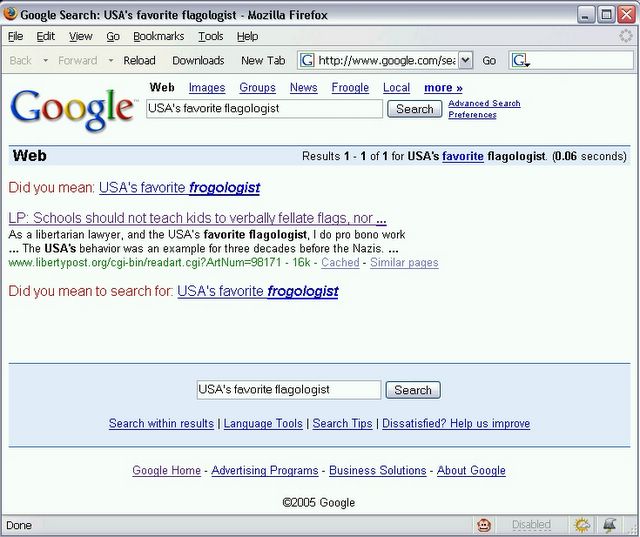
  • Curry calls himself "the USA’s favorite flagologist". As the Google search below shows, it's not likely that he's the foremost expert on flags. And by the way, "flagologist" is apparently Curry's own invention. The word he's looking for is vexillologist.

Stickin' It to the Romantics

In A Portrait of the Artist as a Young Mess, Laurie Fendrich writes
The heart of the problem lies in the fact that ever since the birth of modern art 150 years ago, all artists -- no matter what their visual style or theoretical intention -- have been riding the great wave of Romanticism, which has been rolling across the arts for almost 300 years. With Romanticism, the autonomous self as the basis for all knowledge trumps everything. And even though the Romantic, "authentic" self of Odilon Redon or Lee Krasner has been adulterated by postmodernism and turned into a constructed, artificial self, today's artists remain exactly like their early modern counterparts. Deep down, they consider themselves to be morally superior to nonartists -- more intensely emotional and sensitive -- and pitted against a cold and corrupt society.
The last sentence may be true, but why fault Romanticism?
Artists justified the esoteric nature of modern art with the idea that if something came from an authentic artist, it didn't need orthodox social justification. Modern artists defined their work as worthy, and themselves as special people, simply because they were artists. The audience for modern art long ago gave up expecting or wanting skills, talent, or beauty from artists and willingly acceded to the idea that an artist is a creative outsider whose usefulness lies mainly in being critical of everything. Think "court jester" without the humor.

Before modern art, though, artists had to take account of the larger society because they were forced to, by either the limits of patronage or official censorship. Since the advent of modern art, however, few if any artists consider the larger society beyond the art-world cognoscenti. To do so would mean either selling out to some version of Thomas Kinkadian aesthetics or, equally frightening, assuming a massively difficult chore.
And earlier Dylan Evans claimed Beethoven was a narcissistic hooligan (Seriously!)
...From the speculations of Pythagoras about the "music of the spheres" in ancient Greece onwards, most western musicians had agreed that musical beauty was based on a mysterious connection between sound and mathematics, and that this provided music with an objective goal, something that transcended the individual composer's idiosyncrasies and aspired to the universal. Beethoven managed to put an end to this noble tradition by inaugurating a barbaric U-turn away from an other-directed music to an inward-directed, narcissistic focus on the composer himself and his own tortured soul.

This was a ghastly inversion that led slowly but inevitably to the awful atonal music of Schoenberg and Webern. In other words, almost everything that went wrong with music in the 19th and 20th centuries is ultimately Beethoven's fault...

It's instructive to compare Beethoven's morbid self-obsession with the unselfconscious vivacity of Mozart. Like Bach's perfectly formed fugues and Vivaldi's sparkling concertos, Mozart's music epitomises the baroque and classical ideals of formal elegance and functional harmony; his compositions "unfold with every harmonic turn placed at the right moment, to leave, at the end, a sense of perfect finish and unity", as the music critic Paul Griffiths puts it. Above all, Mozart's music shares with that of Bach an exuberant commitment to the Enlightenment values of clarity, reason, optimism and wit.

With Beethoven, however, we leave behind the lofty aspirations of the Enlightenment and begin the descent into the narcissistic inwardness of Romanticism. Mozart gives you music that asks to be appreciated for its own sake, and you don't need to know anything about the composer's life to enjoy it. Beethoven's music, on the other hand, is all about himself - it is simply a vehicle for a self-indulgent display of bizarre mood swings and personal difficulties.

[Beethoven's] dark and frenzied setting of Schiller's Ode to Joy [in his Ninth Symphony]...is the joy of madness, bloodlust and megalomania. It is glorious music, and seductive, but the passions it stirs up are dark and menacing.
How did Evans miss blaming the Holocaust on Beethoven? Is this totally insane, or what? It reminds me of those filthy inkblots my shrink showed me. (Norman Geras had a similar reaction to the Beethoven article.) Still, while I'm not going to fault Beethoven or Jackson Pollock for that matter, if the ultimate result is a push to return to fundamentals and away from self-indulgence, that sounds great to me.
Monday, June 13

The Dissident

Václav Havel
The dissident does not operate in the realm of genuine power at all. He is not seeking power. He has no desire for office and does not gather votes. He does not attempt to charm the public, he offers nothing and promises nothing. He can offer, if anything, only his own skin-and he offers it solely because he has no other way of affirming the truth he stands for. His actions simply articulate his dignity as a citizen, regardless of the cost.
Citation here. I orginally saw it here. I still don't know the original context. Margo Kingston presents it thus:
Czech President and freedom fighter, Vaclav Havel, says this about power in society: "The [net activist] dissident does not operate in the realm of genuine power at all. His actions simply articulate his dignity as a citizen, regardless of the cost."
She must be referring to Tim Blair.

Sunday, June 12

Life is Tough All Over

A lot of Americans are up in arms (get it?) about the British doctors who are calling for a ban on long pointed kitchen knives to reduce deaths from stabbing. Here at my mother-in-law's we've got a handful of pointy paring knives, and no rounded knives for spreading peanut butter or the overly sweet Duo Penotti that I spread on toast. Not exactly Huevos rancheros.

In Which I Praise Howard Dean

The title Dean Urges Appeal to Moral Values scared me a little, but I liked to hear this:
A moral value is personal responsibility and individual freedom. And that is what Democrats are going to start to stand for -- moral values.
The context was his derision at the attempted congressional intervention in the case of Terri Schiavo, but it has wider implications, no?

Sheeple

Liquor Makers Offering Luxury by the Glassful: 'Mentoring' Part of Push to New Generation By Michael S. Rosenwald
Matt Stutts is...sitting with a couple of buddies, about to sample 18-year-old Scotch that costs about $80 a bottle. But this liquor is free, part of Johnnie Walker's efforts to "mentor," as company executives put it, a new generation of Scotch drinkers. Here come more women in black, holding bottles of Scotch against their chests, offering tidbits of history (Johnnie Walker's grandson came up with the recipe for JW Gold) and forecasting the pleasures of the palate (hints of raisin, vanilla).

"Being co-opted is so great," Stutts says. "I love this."
Freedom is a great thing, but this guy's desire to be manipulated sounds pathetic to me.


Scenes like that...are elaborately staged by the world's biggest liquor producers, who have discovered in the past several years a winning recipe for increasing their sales while flattening those of their competitors, the beer companies.

Using carefully scripted on-premise marketing as the linchpin of hundred-million-dollar ad campaigns, the $15 billion-a-year liquor industry is pushing the concept of affordable luxury into the hands of people in their twenties and thirties as they lean over bars to order drinks. The idea is to get them to order not just a martini, but a Grey Goose vodka martini. To not just do shots of tequila, but to sip Jose Cuervo Reserva. To not order Scotch on the rocks, but Johnnie Walker Gold.
And women can be just as foolish as men.
Luisa Calderon, 28, a radio marketing executive, stood at the bar with her friend, Rossanna Hernandez, 30, a consultant with Ernst & Young. "Our lives may not be as glamorous as the girls on 'Sex in the City,' " Calderon said. "But that doesn't mean we can't try."

Hernandez agreed: "We can live vicariously through them by drinking nice liquor."..

"That's the key here. These companies set up a stage that lends itself to sophistication," said Michael C. Bellas, chief executive of Beverage Marketing Corp. a research firm. "These young people carry on dialogues with their friends. These people are attractive. They'll go out and talk to people about what Johnnie Walker is and how it tastes. That's marketing."...

Liquor companies are aiming at consumers one by one, courting people like Stutts. During the first part of the evening at the Topaz, as Stutts and two friends sampled crab cakes and Cajun shrimp wrapped in bacon, they reflected on how their tastes have changed since being drawn into the Johnnie Walker orbit at a previous event.

Stutts, for example, said he drank whiskey before, but it was often whatever he got his hands on, and never something he ordered by name.

Now Johnnie Walker is his drink of choice. "It's all about finding something that you like," Stutts said.

"If we want a Scotch we know it by name," said his friend, Mark Cutler.
Please, please lead me! Tell me what I like!
Their glasses empty, a woman approached their table. She offered the bottle suggestively. In the midst of being branded, they were enjoying every minute of it.

"Would you like to touch it?" she asked.
Extra points to Rosenwald for the sarcasm.

Be Quick About It

Download all nine of Beethoven's symphonies.

It's Only a Book

Who's Really Abusing the Koran? by Max Boot:
On at least six occasions, Korans were ripped up. They were urinated on three times, and attempts were made to flush them down the toilet at least three other times.

Why aren't millions of Muslims rioting in response to these defilements? Because the perpetrators were prisoners, not guards...

Too bad Islamic states such as Saudi Arabia, far from handing out Bibles at government expense, make it a crime to possess that holy book. Too bad Islamic fanatics have no compunction about blowing up churches and synagogues and slaughtering Christians and Jews. Too bad the murderous intolerance of Sunni terrorists extends to Shiite "idolaters" as well.

All the bombings of Shiites in Iraq have resulted not only in the deaths of thousands of Muslims but also, I imagine, the destruction of quite a few Korans.

It would be nice if the global Islamic community, the news media and assorted human rights agitators could display the same level of outrage about the real atrocities perpetrated by our enemies as they do about the imaginary horrors of the American Gulag.
Now if I were imprisoned and forced to read some "holy" book, that would be torture for me.

Friday, June 10

Atheism Lite

Like Matt Kramer,
I'm completely devoid of religious sentiment, and indeed I find it bewildering that anyone past the age of eight could retain a belief in God any more than in Santa Claus or the tooth fairy.
But like Norman Geras
I see religion as meeting certain deep human needs and anxieties irrespective of its truth value....religious belief has no monopoly on harm; conversely, good is not exclusively associated with the irreligious. It is not religious belief as such which leads to persecution, torture, murder, it is dogmatic and intolerant belief of every kind. Think of the millions killed in the last 150 years in the name of political beliefs, including would-be socialist and liberal beliefs as well as racist and fascist ones, deaths that cannot be laid at the door of religious faith. At the same time, it is a straightforward empirical fact that countless numbers of people - and I use 'countless' here advisedly and literally, not just loosely to convey the sense of very many - have been moved by their religion to do good in the world, to behave well. And this is to say nothing of what they have been moved to create.
So I can't go along with Salman Rushdie's Just give me that old-time atheism! Yet at the same time, I can't really blame him.

Update
Nor can I blame Ayaan Hirsi Ali and her campaign against Islam, which according to her could be considered a backward religion. But aren't they all backward?

Evil White Men

Perry de Havilland (via The Belmont Club)

Robert Mugabe continues his insane demolition of houses and businesses as he increasingly starts to look like Pol Pot reborn, seeking to depopulate the cites and drive the now homeless and unemployed population into the countryside to eke out an even more miserable living, thereby dispersing and isolating people from communities which might oppose his tyrannical rule.

And where are the marchers in the west? Where are the protesters calling for justice in Zimbabwe? Where is the outrage from those tireless tribunes of the Third World, the UN? Why can I not hear the snarls of fury from the alphabet soup of NGOs? What of the legions of Guardian readers finding out about all this? What are they going to call for? Amnesty International is getting a lot of (bad) publicity from having called Guantanamo Bay 'a gulag' whilst now admitting they do not actually know what is happening there, yet why are they not straining every fibre of their being in opposition to this African horror? There is tyranny aplenty to be opposed without having to invent any.

Although to be fair, Amnesty International has reported Zimbabwe: Thousands of forced evictions and arrests in violent crackdown:
Over the past two weeks the Government of Zimbabwe has orchestrated the forced eviction of thousands of informal traders and families living in informal settlements across the country as part of a crackdown called "Operation Murambatsvina" – widely translated as "drive out the rubbish" but being referred to by police as "operation restore order".

Evictions are being carried out without notice and without court orders in a flagrant disregard for due process and the rule of law. During the forced evictions police and other members of the security forces are using excessive force -- burning homes, destroying property and beating individuals.
("Widely translated as"? What language is the phrase in?)

Wednesday, June 8

Nutrition etc.

NutritionData is a little more user-friendly than the USDA National Nutrient Database for Standard Reference. It's also got a firefox plugin. Not that it matters, now that it's OK to be fat. Me, I'm superficial and think that skinny is better-looking than fat. It's funny what you get programmed to think.

Estate Tax Again

FactCheck.org argues that the estate tax doesn't really affect that many people. It doesn't really address the article I mentioned earlier, though.

Feh.

First I tripped and fell on the sidewalk--I got a little scab--and now I've got "swimmer's ear". No swimming for the next few days.

Serves 'em right

U.S. Cities Urged to Adopt 'Congestion Tax' By Terence Chea. The mayor of London, Ken Livingstone,
...told dozens of world mayors that they could unclog city streets and fight global warming by charging hefty fees for driving in congested areas of their communities.
It sounds like a great idea to me, but I don't think Americans will accept it. Coincidentally, America's great headache points out
"Long queues at restaurants or theatre box-offices are seen as signs of success," says Brian Taylor, director of the Institute of Transportation Studies at UCLA. He thinks congestion "is an inevitable by-product of vibrant, successful cities". The examples of Paris, London and New York all show he has a point.
Not everyone thinks so.
Hence the search for remedies—each of which comes with its own problems. More public transport?
It's not only expensive.
Public transport works well when there is a central hub—like Manhattan. But the Californian sprawl is "multimodal": it works on the basis that everybody can go everywhere...

Driving alone explains why car-pool lanes have a limited appeal. High Occupancy Vehicle (HOV) lanes stretch for a mere 1,112 miles of California's freeway system—and are often virtually empty. One idea is Mr Schwarzenegger's decision, still awaiting federal approval, to let fuel-efficient hybrid cars use the HOV lanes whether they have passengers or not.

In the end, virtually all the solutions involve making drivers pay. More realistic fuel prices would make a difference....

Road-pricing has been a little more successful... High Occupancy Toll (HOT) lanes...allow single drivers to drive on them for an extra fee—with the toll collected electronically and varying according to the level of congestion.

Early criticism...was that a HOT lane amounted to a "Lexus lane", favouring the wealthy solo mogul over the blue-collar pick-up-truck driver. In practice, it has worked out more democratically. Mr Taylor says 250,000 drivers have bought the transponders needed for the electronic billing system, and they use them—rich and poor alike—when speed is important.

The paradox, say the sceptics, is that HOT-lanes, like HOV-lanes, may actually increase car use: by freeing up extra capacity on the freeways, they allow more cars to use them. Nonetheless, simply to get at least some people from A to B quickly, it would surely be sensible to make more HOT-lanes available.

Another scheme being mooted in San Francisco is to imitate London and impose a congestion charge on drivers who enter the central area of the city. Jake McGoldrick, chairman of the San Francisco County Transportation Authority, calls this "a home run": it would relieve congestion, lessen pollution and provide money for public transport. Unfortunately, there are relatively few other American cities with the public transport systems in place to follow the London example—and voter opposition would be a near-certainty.

In some cases, fighting congestion does not mean Californians coming up with ingenious ways to prevent it, so much as stopping doing things that encourage it. Donald Shoup and Michael Manville, colleagues of Mr Taylor at UCLA, point to the way that Los Angeles requires both office and residential buildings to provide parking spaces for their tenants. Whereas New York and San Francisco have strict limits on parking in their central business districts, Los Angeles "pursues a diametrically opposing path"...

California is a car culture—as is most of suburban America. Congestion is the inevitable result. Politicians could reduce that congestion by charging motorists more for the petrol they guzzle and the roads they use. But it will only be a change at the margin. Californians have the traffic they deserve.

White Man's Flies

This pun strikes even me as execrable: To bee or not to bee
The varroa mite, a bee parasite first found in Java a century ago, spread to America in 1987 and has recently taken hold (as it has in many other countries). It sucks the blood of both wild and cultivated bees, and has now become immune to pesticides. This year, the steady loss of bees—their numbers have fallen by about 50% in six months—has especially hurt the Californian almond industry, which accounts for 88% of the world's almond crop. Farmers think yields may fall by as much as 16%.

Honey bees landed in the colonies, from England, at about the same time as the Pilgrim Fathers. Soon "the white man's flies", as the Indians called them, generated a thriving industry.
Anyway, I thought it was interesting that bees were not native to North America.

Monday, June 6

Huevos rancheros con papas

According to What Americans Eat for Breakfast by GARY LANGER, huevos rancheros for breakfast is either inspired or bizarre. I've got to remember to try that for breakfast again; my Anglo father made that on occasion. Yum. These days, my breakfast currently ranges from toast or oatmeal or corn pancakes to 小燒餅, 肉粽子, 蛋餅 or 小籠包. I remember in Singapore I used to have egg paratha with curry sauce for breakfast. Take that, Langer.

A Word to the Wise

Tang Chuchen's 唐楚臣 中华彜族虎傩 might have some connection to the stories discussed in Sacred Metamorphosis: the Weretiger and the Shaman.

Friday, June 3

[shpritz!] Trust me!

Hormone Spray Is Found To Bolster Trust in Others By Shankar Vedantam
Scientists have found the chemical equivalent of the perfect sales pitch: a hormone that makes us more trusting than we normally are...

The experiment has profound implications about the nature of human trust.
I'll say!
Researchers said their finding might lead to cures for people with disorders that prompt them to hold others at arm's length, but they acknowledged that the chemical, which is widely used in medicine, could be misused.
Ya think?
Trust is central to virtually every positive social relationship, from intimate love and friendships to financial transactions and politics, but little had been learned about its biological correlates in the brain, researchers said. Oxytocin is known to be activated in a range of social relationships in many animals, but this is the first time scientists have shown that it can serve as a switch to enhance trust in human relationships...

"Some may worry about the prospect that political operators will generously spray the crowd with oxytocin at rallies of their candidates," said neurologist Antonio R. Damasio of the University of Iowa, who has long studied the neurobiology of human emotions and who wrote a commentary accompanying the study.

At the same time, he added in an interview, politicians and marketers were probably already triggering the natural release of oxytocin in the brains of audiences through their campaigns. "I am more alarmed about the manipulations of marketing than the possibility of oxytocin sprays," he said.
Easy for him to say. Admittedly the results are preliminary, but this guy looks like he absolutely refuses to believe it.
Brent Waters, an associate professor of Christian social ethics at the seminary, which is affiliated with Northwestern University, questioned whether trust could be so easily reduced to chemical constructs. "The experiment presupposes a highly diminished and reductionistic understanding of what trust means," he said.

Using a watch as a compass

The things one learns from movies. I learned this from The Edge (1997):
Point the hour hand at the sun when you are north of the equator. South will be halfway between the hour hand and 12 o'clock.
Of course there are other ways. As for the movie, it was OK. I'm fond of Anthony Hopkins, but Alec Baldwin has always struck me as very much a B actor.

Wait a minute! No wonder this didn't work in Taiwan!
...if you are within or very close to the tropics, the determination of north or south as described above may not be reliable
(from Using the Sun to Orient Yourself)

Reforestation of North America

How Non-Green Cities Are Rebuilding the American Forests by Peter Huber and Mark Mills
When Europeans first arrived--after millenniums of deforestation by fire, promoted by American Indians--the area now represented by the lower 48 United States had about 950 million acres of forest. That area shrank steadily until about 1920, to a low of 600 million acres. It has been rising ever since.