Instead of debt relief and more aid, many Africans said they wanted the G-8 to focus on ending corruption and on improving roads, courts, banking and secondary education.Can't you see the demonstrators at the Live 8 concerts asking for this?
Another useful step, many Africans said, would be to end Western countries' trade subsidies for their own farmers, which make it impossible for African industries to do much more than survive. Debt relief, some asserted, is actually hush money to get free trade advocates off the backs of European countries, the United States and Japan, which offer huge subsidies to their corn, cattle and cotton farmers and thus undercut African farmers' ability to enter the market.
Sunday, July 3
End Western Countries' Trade Subsidies
Among Ordinary Africans, G-8 Seems Out of Touch By Emily Wax says that


Someone Who Represents Who I Am
In O'Connor Successor Debated Amy Argetsinger and Elizabeth Williamson refer to Victoria Toensing, a Republican and a deputy assistant attorney general from 1984 to 1988, who says, "It is important for people to look at the Supreme Court and say there's someone on that court who represents who I am." Gee, wherever I look, I am unable to find anyone who "represents who I am". What nonsense.
Saturday, July 2
Why Post the Ten Commandments?
Inspired by Eugene Volokh, I note:
Only three are currently enforced: #6 "Thou shalt not kill", #8 "Thou shalt not steal" and #9 "Thou shalt not bear false witness against thy neighbour".
We used to take others seriously: #4 "Remember the sabbath day, to keep it holy. Six days shalt thou labour, and do all thy work: But the seventh day is the sabbath of the LORD thy God: in it thou shalt not do any work..." Yeah, right. I'm old enough to remember most places were closed on Sundays, but even then restaurants were open. Similarly, #7 "Thou shalt not commit adultery" used to be a big deal, but not any more.
Did we ever make laws regarding #5 "Honour thy father and thy mother..."?
The First Amendment would prohibit the government from enforcing #1 "Thou shalt have no other gods before me" as well as #3 "Thou shalt not take the name of the LORD thy God in vain."
I'm not sure which is more contrary to current American life, number ten or number two. #10 "Thou shalt not covet thy neighbour's house [etc.]" Coveting is pretty much the way of life for most Americans. Even if the Taliban would go for #2 "Thou shalt not make unto thee any graven image, or any likeness of any thing that is in heaven above, or that is in the earth beneath, or that is in the water under the earth. Thou shalt not bow down thyself to them, nor serve them..." Pictures and other likenesses of living things have been acceptable for centuries, even among most Christians.
So the question is, why post the ten commandments in court houses if over half of them are irrelevant to modern American life? On the other hand, if they're irrelevant, who gives a good god damn, I wish I had that car.
Only three are currently enforced: #6 "Thou shalt not kill", #8 "Thou shalt not steal" and #9 "Thou shalt not bear false witness against thy neighbour".
We used to take others seriously: #4 "Remember the sabbath day, to keep it holy. Six days shalt thou labour, and do all thy work: But the seventh day is the sabbath of the LORD thy God: in it thou shalt not do any work..." Yeah, right. I'm old enough to remember most places were closed on Sundays, but even then restaurants were open. Similarly, #7 "Thou shalt not commit adultery" used to be a big deal, but not any more.
Did we ever make laws regarding #5 "Honour thy father and thy mother..."?
The First Amendment would prohibit the government from enforcing #1 "Thou shalt have no other gods before me" as well as #3 "Thou shalt not take the name of the LORD thy God in vain."
I'm not sure which is more contrary to current American life, number ten or number two. #10 "Thou shalt not covet thy neighbour's house [etc.]" Coveting is pretty much the way of life for most Americans. Even if the Taliban would go for #2 "Thou shalt not make unto thee any graven image, or any likeness of any thing that is in heaven above, or that is in the earth beneath, or that is in the water under the earth. Thou shalt not bow down thyself to them, nor serve them..." Pictures and other likenesses of living things have been acceptable for centuries, even among most Christians.
So the question is, why post the ten commandments in court houses if over half of them are irrelevant to modern American life? On the other hand, if they're irrelevant, who gives a good god damn, I wish I had that car.
Friday, July 1
Do As I Say--Not As I Do
Greenhouse Hypocrisy By Robert J. Samuelson
Political leaders everywhere deplore global warming -- and then do little.It's not just the leaders--it's the public, too. Granted in most big cities and in many small towns getting out of the car and taking public transport, walking, or biking would be a major sacrifice, in the college town where I live, one sees few faculty, staff, or students walking or biking.
Thursday, June 30
Bottled water is not always purer than tap water
The Claim: Bottled Water Is Cleaner Than Tap Water By ANAHAD O'CONNOR
While many large cities are required to regularly disinfect their water supplies and test for parasites, bottled-water manufacturers are not.
Tuesday, June 28
Friday, June 24
One Way to Get Famous
On 25 May 2005, Richard Phillips, a senior associate at the London office of international law firm Baker & McKenzie e-mailed Jenny Amner, a secretary at the same firm, informing her that it would cost £4 to remove the ketchup stains from his trousers for which Ms. Amner was presumably somehow responsible, and asked her to provide him with the cash by the end of the day. In June 2005 a brief e-mail exchange between the two was leaked outside the firm, turning Mr. Phillips into a figure of derision around the world. via snopes.com
Thursday, June 23


The pointy-haired boss is French
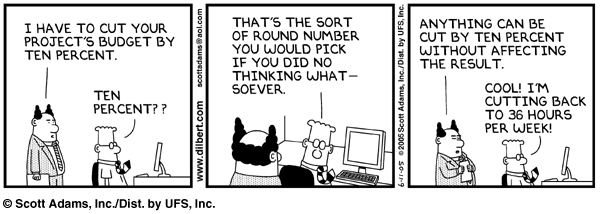
What has the 35-hour week actually done?
- the policy has destroyed the work ethic and damaged productivity
- the 35-hour week has created a two-tier labour market
- employers are using short-term or temporary contracts to gain flexibility
- France's jobless rate is still nearly 10%—twice that in Britain—and 22% for under-25s
Wednesday, June 22
Optimists
Mark Krikorian reviews The Empty Cradle: How Falling Birthrates Threaten World Prosperity and What to Do About It by Phillip Longman and Fewer: How the New Demography of Depopulation Will Shape Our Future by Ben J. Wattenberg, saying,
...the U.S. is exceptional. Our birthrates have fallen, and thus the average age of our people has increased, but it has happened more gradually than elsewhere. What's more, our population is projected to keep growing. This is not only because of immigration, as Wattenberg suggests, but because of higher fertility among native-born women; even college-educated, non-Hispanic white women have a total fertility rate of 1.7 children, higher than the overall rates of Canada, Britain, or Australia, not to mention the even lower rates of Japan, Germany, Italy, and Spain.The reviewer's singling out optimism is interesting. In that Pew Political Typology that I took issue with earlier, Part of the analysis was Personal Optimism a Dividing Line
Within the context of falling birthrates worldwide caused by urbanization, education, and the rest, Americans, as both a more religious and more optimistic people, simply choose to have more children. In fact, the only Census Bureau scenario that foresees a declining U.S. population in this century is based on the highly unlikely assumptions that, first, the fertility of American women will fall to European levels, and second, immigration will be reduced to levels below even what most restrictionist organizations call for. Barring catastrophe, then, the population of the U.S. will not decline during the lifetime of anyone reading this article.
Pro-Government Conservatives and Disadvantaged Democrats have similar socioeconomic backgrounds and confront many of the same financial struggles. Both groups are predominantly female, both are relatively poor, and large majorities in both groups express dissatisfaction with their financial circumstances.And then there was Lexington on The Party of hope and growth.
But these groups have strikingly different outlooks on their lives and possibilities that go a long way toward explaining the differences in their political attitudes. Feelings about the power of the individual are a major factor in this division. Pro-Government Conservatives are defined, at least in part, by their optimism in this area. About three-quarters (76%) believe that most people can get ahead if they are willing to work hard and two-thirds (66%) strongly express that view. An even higher percentage of Pro-Government Conservatives (81%) say that everyone has it in his or her own power to succeed.
Disadvantaged Democrats have a gloomier outlook. Just 14% think that people can get ahead by working hard; 79% say that hard work is no guarantee of success, and 76% express that view strongly. Only 44% of Disadvantaged Democrats say that everyone has the power to succeed, while slightly more (47%) take the fatalistic view that success in life is determined by forces outside one's own control.
More broadly, opinions on personal empowerment deeply divide both the Democratic groups and independents. More than eight-in-ten Conservative Democrats (83%) think that most people who work hard can get ahead, while Liberals are somewhat less likely to subscribe to this view and Disadvantaged Democrats strongly disagree. Among center groups, Upbeats, by definition, are very optimistic on this point, and Disaffecteds much less so.
Tuesday, June 21
You're not oppressed! You're not gay!
"What do you have to write about? You're not oppressed! You're not gay!" (John Lithgow, to his son, an aspiring novelist, in Orange County) which was written by Mike White. Not much of a movie, but a great line.
Wait'll This Becomes Popular
Robo-Legs By MICHEL MARRIOTT
While some users are eager to display their prosthetic marvels, many of which are paid for by private and public health insurance, others like to have them modeled to appear more human...We're only seeing the tip of the iceberg with today's body modifications.
Hope Harrison, a professor of history and international affairs at George Washington University in Washington, had a leg amputated in 1979. Ms. Hope, 43, said she had used a range of prosthetics, but preferred the C-Leg now. She also prefers to wear it with a natural-looking cover.
"It's one thing to see a man with a Terminator leg," Ms. Harrison said, referring to the cybernetic character played by Arnold Schwarzenegger in the blockbuster movie series. "It may inspire people to say, 'Cool.' But body image for women in this country is model thin and long sexy legs."
But young men, especially those who have been using personal electronics since childhood, are comfortable recharging their limbs' batteries in public and plugging their prosthetics into their computers to adjust the software, Mr. Hanson said.
When Did Cappuccino Become a Necessity?
A bunch of people are disturbed by Blaine Harden's Javanomics 101. Almost everyone, including Harden, seems to be missing the point, although Harden comes close:
I'm fond of cappuccino myself, but I almost never buy it at home in the US--it's just too expensive. I bring my own coffee, which is far from cappuccino. Given the reaction of these various bloggers to the article, it looks like I'm pretty eccentric, but I think they're pretty foolish to let themselves get hooked this way.
Financial planners, best-selling investment gurus and a number of advice columnists have been warning consumers for years that seemingly insignificant daily spending on such luxuries as gourmet coffee can, over time, sabotage savings and hobble a person's financial future.The thing is, it's not just luxuries. Spending too much on anything is a dumb way to manage one's finances. Only Head of Royal Intelligence seems to get the point.
I'm fond of cappuccino myself, but I almost never buy it at home in the US--it's just too expensive. I bring my own coffee, which is far from cappuccino. Given the reaction of these various bloggers to the article, it looks like I'm pretty eccentric, but I think they're pretty foolish to let themselves get hooked this way.
Taiwan Coffee
In contrast to the US, the Taiwanese for the most part don't drink their cappuccino in the morning, at least not while I'm buying mine (around 7-8 am). While it's true that the Taiwanese generally get up and out much later than they used to, and later than most Americans seem to, there's not a lot of coffee available at the the ordinary breakfast places. Fortunately for me, the estimable Crown coffee 金鑛咖啡麵包 is open 24 hrs., and there's a branch near where we live, so I get my iced cappuccino a couple of times a week but not more often even though it's NT$50, about US $1.70.
I note that two of the branches have recently expanded and are now selling various breads in addition to the tiny patisseries (I can't say pastries because they're much too delicate for that). But like virtually all bakeries here, they don't bake their stuff early in the morning but in the middle of the day. Not that it makes much difference. Taiwan breads are getting less and less interesting to me.
I note that two of the branches have recently expanded and are now selling various breads in addition to the tiny patisseries (I can't say pastries because they're much too delicate for that). But like virtually all bakeries here, they don't bake their stuff early in the morning but in the middle of the day. Not that it makes much difference. Taiwan breads are getting less and less interesting to me.
Saturday, June 18
Dumb Intellectuals
Wesley Yang's The philosopher and the ayatollah, a review of Foucault and the Iranian Revolution, by Kevin Anderson and Janet Afary:
Foucault's Iranian adventure was a "tragic and farcical error" that fits into a long tradition of ill-informed French intellectuals spouting off about distant revolutions, says James Miller, whose 1993 biography The Passion of Michel Foucault contains one of the few previous English-language accounts of the episode...Foucault's dismissal of "Atoussa H." has an echo in more recent attacks on Ayaan Hirsi Ali, not all of them by leftists. But the question remains why so many educated Westerners are so bitter about their own culture. I imagine many of them agree with his judgement about "Industrial capitalism". It's as if they've never lived it.
[Foucault] was France's dominant public intellectual, famous for a critique of modernity carried out through unsparing dissections of modern institutions that reversed the conventional wisdom about prisons, madness, and sexuality. In his most famous work, "Discipline and Punish," Foucault argued that liberal democracy was in fact a "disciplinary society" that punished with less physical severity in order to punish with greater efficiency. More broadly, his counternarrative of the Enlightenment suggested that the modern institutions we imagined were freeing us were in fact enslaving us in insidious ways...
In an interview with an Iranian journalist conducted on his first visit, in September 1978, Foucault made plain his disillusionment with all the secular ideologies of the West and his yearning to see "another political imagination" emerge from the Iranian Revolution. "Industrial capitalism," he said, had emerged as "the harshest, most savage, most selfish, most dishonest, oppressive society one could possibly imagine."
...Foucault never considers the rights of women in Islam until his very last disillusioned missive, which appeared in Le Monde in May 1979. When an Iranian woman living in exile in Paris named "Atoussa H." wrote a letter to Le Nouvel Observateur in November 1978 castigating Foucault for his uncritical support of a solution that could prove to be worse than the problem, he airily dismissed her claims as anti-Muslim hate-mongering...
There is a long tradition of Western intellectuals going abroad to sing the praises of revolutionaries in distant lands and finding in them the realization of their own intellectual hopes...
Anderson says that the debate over these 25- year-old writings has relevance when some leftists focus more energy on criticizing an administration they scorn than on speaking against a radical Islamist movement that also violates all their cherished ideals.
"It's not that radical Islamism is getting a pass from Western progressives and liberals, but it is the case that many are not being critical enough," says Anderson. When certain polemicists are spreading simplistic ideas about "Islamo-Fascism," he continues, "there's a tendency to say that this isn't so. But the fact is that while radical Islamism has many features and faces, everywhere it is antifeminist, everywhere it is authoritarian, and everywhere it is intolerant of other religions and other interpretations of Islam."
Thursday, June 16
Acquiescing in Their Own Decline
The End of Europe By Robert J. Samuelson
Europe as we know it is slowly going out of business...Wow. Bad news.
It's hard to be a great power if your population is shriveling...
No one knows how well modern economies will perform with so many elderly people, heavily dependent on government benefits (read: higher taxes). But Europe's economy is already faltering. In the 1970s annual growth for the 12 countries now using the euro averaged almost 3 percent; from 2001 to 2004 the annual average was 1.2 percent. In 1974 those countries had unemployment of 2.4 percent; in 2004 the rate was 8.9 percent.
Wherever they look, Western Europeans feel their way of life threatened. One solution to low birthrates is higher immigration. But many Europeans don't like the immigrants they have -- often Muslim from North Africa -- and don't want more. One way to revive economic growth would be to reduce social benefits, taxes and regulations. But that would imperil Europe's "social model," which supposedly blends capitalism's efficiency and socialism's compassion...
The trouble is that so much benevolence requires a strong economy, while the sources of all this benevolence -- high taxes, stiff regulations -- weaken the economy. With aging populations, the contradictions will only thicken. Indeed, some scholarly research suggests that high old-age benefits partly explain low birthrates. With the state paying for old age, who needs children as caregivers? High taxes may also deter young couples from assuming the added costs of children.
...in general Europe is immobilized by its problems. This is the classic dilemma of democracy: Too many people benefit from the status quo to change it; but the status quo isn't sustainable. Even modest efforts in France and Germany to curb social benefits have triggered backlashes. Many Europeans -- maybe most -- live in a state of delusion. Believing things should continue as before, they see almost any change as menacing. In reality, the new E.U. constitution wasn't radical; neither adoption nor rejection would much alter everyday life. But it symbolized change and thereby became a lightning rod for many sources of discontent (over immigration in Holland, poor economic growth in France).
All this is bad for Europe -- and the United States. A weak European economy is one reason that the world economy is shaky and so dependent on American growth. Preoccupied with divisions at home, Europe is history's has-been. It isn't a strong American ally, not simply because it disagrees with some U.S. policies but also because it doesn't want to make the commitments required of a strong ally. Unwilling to address their genuine problems, Europeans become more reflexively critical of America. This gives the impression that they're active on the world stage, even as they're quietly acquiescing in their own decline.
Wednesday, June 15
Tweaks
I found Optimize XP when I was looking for a way to disable the windows startup sound. As directed, I went to "Start", "Settings", "Control Panel", "Sounds and Audio Devices", selected the "Sounds" tab, under "Sound Scheme" selected "No Sounds".
I also followed their instructions to improve Windows XP performance, which included going "Start", "Settings", "Control Panel", "System", "Advanced" tab, and in the "Performance" section selecting "Settings". I left only the following checked:
I also uninstalled "Indexing Service" and "MSN Explorer" by going to "Start", "Settings", "Control Panel", "Add or Remove Programs", selecting "Add/Remove Windows Components", and unchecking them both. Unintsalling "Indexing Service" took a long time.
I also downloaded, installed, and ran Autoruns, XP-Antispy, Cacheman, TweakUI (which is found on the start menu after installation instead of on the control panel), Shoot The Messenger, and Unplug n' Pray.
Finally, I followed the instructions to "Go to Start, Run, type "services.msc" and press enter" and disabled all of the following:
Update
I also defragmented my disk. By disabling "Help and Support" I find that I can no longer access "system information" (or get help, as a matter of fact), and when I tried to check the disk, I get the message "The disk check could not be performed because the disk check utility needs exclusive access to some Windows files on the disk..." Restarting the computer is no help, but this works:
Start-Run
Type in ChkDsk /r /f
Click OK
When it asks you if you want to run ChkDsk the next time you reboot, say YES.
Reboot.
ChkDsk should execute during the reboot.
Note: Be sure to leave a space before /r and /f.
(Thank you siliconman01)
I also followed their instructions to improve Windows XP performance, which included going "Start", "Settings", "Control Panel", "System", "Advanced" tab, and in the "Performance" section selecting "Settings". I left only the following checked:
- Show shadows under menus
- Show shadows under mouse pointer
- Show translucent selection rectangle
- Use drop shadows for icons labels on the desktop
- Use visual styles on windows and buttons
I also uninstalled "Indexing Service" and "MSN Explorer" by going to "Start", "Settings", "Control Panel", "Add or Remove Programs", selecting "Add/Remove Windows Components", and unchecking them both. Unintsalling "Indexing Service" took a long time.
I also downloaded, installed, and ran Autoruns, XP-Antispy, Cacheman, TweakUI (which is found on the start menu after installation instead of on the control panel), Shoot The Messenger, and Unplug n' Pray.
Finally, I followed the instructions to "Go to Start, Run, type "services.msc" and press enter" and disabled all of the following:
- Alerter
- Disable Distributed Link Tracking Client
- Disable Help and Support
- Disable Indexing Service
- Disable IPSEC Services
- Disable Portable Media Serial Number
- Disable Remote Registry Service
- Disable Secondary Logon
- Disable Upload Manager
- Automatic Updates
- Automatic Background Intelligent Transfer Service
- Automatic Com+ Event System
- Automatic Cryptographic Services
- Automatic DCOM Server Process Launcher
- Automatic DHCP Client
- Automatic DNS Client
- Automatic Event Log
- Automatic Logical Disk Manager
- Automatic Network Connections
- Automatic Plug and Play
- Automatic Print Spooler
- Automatic Protected Storage
- Automatic Remote Procedure Call (RPC)
- Automatic Security Accounts Manager
- Automatic Security Center
- Automatic Shell Hardware Detection
- Automatic System Event Notification
- Automatic System Restore Service
- Automatic Themes
- Automatic Windows Audio
- Automatic Windows Management Instrumentation
Update
I also defragmented my disk. By disabling "Help and Support" I find that I can no longer access "system information" (or get help, as a matter of fact), and when I tried to check the disk, I get the message "The disk check could not be performed because the disk check utility needs exclusive access to some Windows files on the disk..." Restarting the computer is no help, but this works:
Start-Run
Type in ChkDsk /r /f
Click OK
When it asks you if you want to run ChkDsk the next time you reboot, say YES.
Reboot.
ChkDsk should execute during the reboot.
Note: Be sure to leave a space before /r and /f.
(Thank you siliconman01)
Social Classes
Minding about the gap
So the problem is the Education Faculties and the unions are standing the way of reforms, and "so many people" are doing too well. How about we find some way to stop these "many people" from doing so well, eh?
...the biggest determinant of how far you go in life is how far you go in education. The gap in income between the college-educated and the non-college-educated rose from 31% in 1979 to 66% in 1997. But access to college is increasingly determined by social class. The proportion of students from upper-income families at the country's elite colleges is growing once again, having declined dramatically after the second world war. Only 3% of students in the most selective universities come from the bottom income quartile, and only 10% come from the bottom half of the income scale.
The obvious way to deal with this is to use the education system to guarantee a level playing field.... Alas, there are at least three big problems with this.
- The first is that the schools the poorest Americans attend have been getting worse rather than better. This is partly a problem of resources, to be sure. But it is even more a problem of bad ideas. The American educational establishment's weakness for airy-fairy notions about the evils of standards and competition is particularly damaging to poor children who have few educational resources of their own to fall back on. One poll of 900 professors of education, for example, found that 64% of them thought that schools should avoid competition.
- The second is the politics of education reform. The Democrats have much deeper roots in poor America than the Republicans; they also have much greater faith in the power of government. But they are too closely tied to the teachers' unions to push for sensible reforms, such as testing and school choice. Their notions of improvement seem limited to pouring in more money.
- The third reason is the most powerful of all: that the educated classes still do such a superb job of consolidating and transmitting their privileges.... America's college-educated class is now a much larger share of the population than it was.
So the problem is the Education Faculties and the unions are standing the way of reforms, and "so many people" are doing too well. How about we find some way to stop these "many people" from doing so well, eh?
Tuesday, June 14
Trifocals
I woke up early this morning and couldn't get back to sleep, so of course I got on the computer. I've already got bifocals, but they were not of much help unless I got close to the screen.
Subscribe to:
Posts (Atom)