Monday, October 24
Another Book I Didn't Buy
Russell Roberts's The Invisible Heart: An Economic Romance. I loved it while I was reading it because like the hero, my understanding of economic topics generally makes me feel like a fish swimming against the tide, although unlike him I generally just keep my mouth shut. Like the endings of a lot of other books, the conclusion struck me as a little flat or contrived. Ironically, maybe the hero's decision to stick with his principles with regard to his employer's decision at the end made it a little downbeat.


No Economic Expert
The other day, Debbie Elliott interviewed Sinan Antoon "a poet, novelist and filmmaker born in Iraq" on Iraq's new constitution. The short interview ends with Elliott asking,
Is there anything in here that clues you to think that maybe this document had not been written entirely by Iraqis?Antoon replies,
Yes. What really raised the red flag for me was the article about how private property is sacrosanct. Private property is something that's acceptable, but the word sacrosanct, why all this emphasis on private property? Why not the rights of the individual are sacrosanct? And we must remember that one of the first laws that Bremer promulgated when he was the leader of the Iraq....was to open the country entirely for foreign investment and allow foreign companies to reinvest zero inside the country, meaning take all of the profit outside. So this emphasis that is sacrosanct is really telling, I think.Property rights are important. What's telling is Antoon's ignorance and the NPR editorial decision to air the views of a poet on the constitution.
Does it Make You Proud?
Motown's Ominous Message By Sebastian Mallaby
Last week's terrible results from Ford; this month's bankruptcy of the big auto parts maker Delphi; and the rising tide of speculation about the potential bankruptcy of GM -- a big cause of all this grief lies in excessive non-wage benefits. Hourly pay may be a little high: It averages about $27 at GM and Delphi, compared with the $17 average for American manufacturing. But health and pension benefits are the real killers. Once you've counted those, workers cost $74 an hour at GM and $65 an hour at Delphi.Probably not.
The size of these benefits is odd. On its face, non-wage compensation is likely to be inefficient. Cash can be spent on exactly what each individual worker wants. But converting cash into benefits inevitably means waste. Some workers won't want the benefits, perhaps because they have a pressing need for money or perhaps because they would have preferred a different sort of pension or health plan. These workers may value the benefits less than it costs to provide them.
Companies provide benefits nonetheless because government encourages them to do so.... More recently, government has pushed the same way by sheltering pension contributions and health premiums from taxes. The resulting company-based welfare system is widely accepted as the way things ought to be. But it's based on a myth of lifetime employment at one firm. And its tax breaks are unfair to self-employed workers who don't get them.
Why did carmakers get to the point where they not only offer pensions and health care, but where these benefits account for the majority of workers' total compensation? Again, the answer has to do with government. The law allows firms to reward workers with valuable benefit promises today, but pay for these promises later. In the car industry, just as in other industries facing a cash crunch, this promise-now, pay-later option has proved irresistible.
The option is clearest in the case of retiree health benefits. The law allows companies to promise health coverage to workers when they retire, but it fails to require them to set aside cash to pay for that obligation. So in bargaining sessions over the years, Detroit's managers and unions have found it easier to make "progress" on health plans rather than on wages that would have to be paid for immediately. For managers, cost-free promises of gold-plated health coverage in the far future bought labor peace. For labor leaders, they impressed rank-and-file members and ensured reelection.
The promise-now, pay-later trick applies to pensions, too, although it is more subtle. The law does require companies to put aside money to fund pension promises -- but not enough money. GM, for example, is allowed by pension accounting rules to report that its pension plans are fully funded. But if the plans were terminated tomorrow, their assets would be worth $31 billion less than GM's promises to retirees. Rules that effectively allow a company to report $31 billion that it doesn't have provide an irresistible temptation. The bigger your pension plan, the more billions in fake assets you'll be able to report. This has done nothing to discourage Detroit's generous retirement promises.
Now the future has arrived. GM is providing gold-plated health plans to more than 1 million retired Americans; its health costs came to $4 billion last year and will top $5 billion this year. These "legacy costs" -- the legacy of bad management decisions encouraged by bad government rules -- are driving the carmakers to the wall. Last week GM forced retirees to swallow cuts in their health plans, and Delphi seems likely to use the bankruptcy courts to impose similarly sour medicine.
...From now on, tax incentives should not encourage welfare systems that depend on the false premise of corporate immortality. And the law should oblige firms to recognize the cost of compensation promises immediately and transparently.
...But the political system has a formidable ability to ignore even the oldest and most obvious lessons. Congress is considering legislation to force proper funding of pensions, but the reform will probably end up full of holes. Likewise, Congress will soon be prompted by the president's tax commission to consider ending the tax shelter for company health premiums, but the people's representatives will no doubt brush that idea aside. Politically unthinkable, we will be told -- and never mind the fact that it may be good policy.
Oh, Howard!
I realize English is tough, but I was disappointed to see HOWARD W. FRENCH write, "His visits back to China are those of a prodigious son...." Surely he means prodigal son.
Sunday, October 23
More weirdness
A year ago last summer, I got a red rash/discoloration on my lower legs. Later my doctor in the U.S. said it was rosacea, and gave me some anti-biotics to get rid of it. It worked, but this fall, it started to come back again. So I guess we can eliminate the late unlamented Kaohsiung 前金游泳池 pool. Anyway, this time I stopped drinking (instant) coffee, and it's started to fade. But rosacea on the legs? It seems pretty weird to me.
Friday, October 21
Shades of Amy Tan's lame Chinese
I didn't much like Rachel DeWoskin's Foreign Babes in Beijing. There is a little too much girly gossip and hand-wringing for me, but there are also a lot of niggling errors.
In discussing Chinese racism, she claims that there is a 黑哥 hēigē ("black brother") toothpaste. The only one I could find was an illegal knock-off. But she says nothing about 黑妹 hēimèi ("black sister") toothpaste.
Then there are many language errors. At one point she says she embarrassed herself by saying 閹割 yāngē ("castrate") instead of 嚴格 yángé ("strict"). She says someone explained to her that people understood her to say that her teachers castrated their students instead of saying that the teachers were strict. Yes, it's funny. But such a misunderstanding on the part of the Chinese doesn't sound likely to me. I believe her companion was just teasing her. In any case, she goes on to claim that "strict" is pronounced with two third tones, which would be yǎngě (and tone sandhi would change that to yángě), but that is simply wrong: 嚴格 is yángé.
At one point she refers to a club called "Jazz Ya", which she glosses as "Jazz Place" in Japanese but "Jazz Duck" in Chinese. But the syllable "ya" can mean many different things in Chinese, depending on how it is written. In the first tone alone, it could be 鴉 "crow" as well as 鴨 "duck", or just 呀 an exclamation, among other things. And there are several other choices:
yā: 押, 椏, 壓
yá: 枒, 芽, 蚜, 牙, 涯, 衙
yǎ: 啞, 雅
yà: 揠, 掗, 軋, 亞, 砑, 迓, 訝, 氬, 婭
The first time she notices the written Chinese title of Foreign Babes in Beijing, the soap opera she is to act in, she sees "a few extra, sexy strokes" in one of the Chinese characters.
First, as to those "sexy" strokes. The phonetic for 妞 is 丑, which was most commonly seen as number two of the duodecimal cycle, but was also used in words like 丑旦 chǒudàn, a woman clown on stage, and now under the simplified character regime, 丑 chǒu is used to mean "ugly". How is that sexy?
As to pronunciation, she can't hear the sound rendered as ü in Chinese. She initially thought the title of the series was 洋女在北京 yáng nǚ zài Běijīng instead of 洋妞在北京 yáng niū zài Běijīng. In other words, she cannot hear the difference between 女 nǚ and 妞 niū.
Similarly, at one point she also says of the title, "I heard 'foreign' and 'niu' and 'in Beijing'. 'Niu' sounded both like 'cattle' and 'girl'". Here she is similarly confusing 牛 niú and 女 nǚ.
She also misspells the pinyin for the second character in the phrase 當局者迷,旁觀者清 spelling it jiu instead of ju (it should be dāngjúzhěmí,pángguānzhěqīng "those closely involved cannot see as clearly as those outside").
And finally, she claims the young woman who "thong-flashed" people was afterwards known as "guang pigu nu", which should be guāng pìgu nǚ; it's that same 女 nǚ that she has so much trouble with.
And even if she had trouble with this, why didn't someone proofread the Chinese? Would W. W. Norton publish a book with Latin misspellings? I guess her father (the retired sinologist Kenneth J. DeWoskin) was too busy.
Shades of Amy Tan's yi ta fa duo!
In discussing Chinese racism, she claims that there is a 黑哥 hēigē ("black brother") toothpaste. The only one I could find was an illegal knock-off. But she says nothing about 黑妹 hēimèi ("black sister") toothpaste.
Then there are many language errors. At one point she says she embarrassed herself by saying 閹割 yāngē ("castrate") instead of 嚴格 yángé ("strict"). She says someone explained to her that people understood her to say that her teachers castrated their students instead of saying that the teachers were strict. Yes, it's funny. But such a misunderstanding on the part of the Chinese doesn't sound likely to me. I believe her companion was just teasing her. In any case, she goes on to claim that "strict" is pronounced with two third tones, which would be yǎngě (and tone sandhi would change that to yángě), but that is simply wrong: 嚴格 is yángé.
At one point she refers to a club called "Jazz Ya", which she glosses as "Jazz Place" in Japanese but "Jazz Duck" in Chinese. But the syllable "ya" can mean many different things in Chinese, depending on how it is written. In the first tone alone, it could be 鴉 "crow" as well as 鴨 "duck", or just 呀 an exclamation, among other things. And there are several other choices:
yā: 押, 椏, 壓
yá: 枒, 芽, 蚜, 牙, 涯, 衙
yǎ: 啞, 雅
yà: 揠, 掗, 軋, 亞, 砑, 迓, 訝, 氬, 婭
The first time she notices the written Chinese title of Foreign Babes in Beijing, the soap opera she is to act in, she sees "a few extra, sexy strokes" in one of the Chinese characters.
First, as to those "sexy" strokes. The phonetic for 妞 is 丑, which was most commonly seen as number two of the duodecimal cycle, but was also used in words like 丑旦 chǒudàn, a woman clown on stage, and now under the simplified character regime, 丑 chǒu is used to mean "ugly". How is that sexy?
As to pronunciation, she can't hear the sound rendered as ü in Chinese. She initially thought the title of the series was 洋女在北京 yáng nǚ zài Běijīng instead of 洋妞在北京 yáng niū zài Běijīng. In other words, she cannot hear the difference between 女 nǚ and 妞 niū.
Similarly, at one point she also says of the title, "I heard 'foreign' and 'niu' and 'in Beijing'. 'Niu' sounded both like 'cattle' and 'girl'". Here she is similarly confusing 牛 niú and 女 nǚ.
She also misspells the pinyin for the second character in the phrase 當局者迷,旁觀者清 spelling it jiu instead of ju (it should be dāngjúzhěmí,pángguānzhěqīng "those closely involved cannot see as clearly as those outside").
And finally, she claims the young woman who "thong-flashed" people was afterwards known as "guang pigu nu", which should be guāng pìgu nǚ; it's that same 女 nǚ that she has so much trouble with.
And even if she had trouble with this, why didn't someone proofread the Chinese? Would W. W. Norton publish a book with Latin misspellings? I guess her father (the retired sinologist Kenneth J. DeWoskin) was too busy.
Shades of Amy Tan's yi ta fa duo!
Contradictory Obama
Here's Senator Obama's reply to my note urging him to cut the pork.
Thank you for writing me with your concerns about the cost of rebuilding the Gulf Coast in the wake of Hurricane Katrina. I appreciate the benefit of your comments and your suggestions for how we should pay for this effort. Congress has already approved more than $62 billion for relief and recovery efforts, and significantly more spending is expected in the months ahead.(Emphasis mine.) But he still voted against the Coburn anti-pork amendments.
The American spirit of resilience and determination demands that we rebuild the Gulf Coast, and we will. It is important, however, that we rebuild the devastated areas sensibly while being fiscally responsible.
First, we must resist calls for further tax breaks for the wealthy. Enacting more tax cuts, or extending the President's first-term cuts for the wealthiest of Americans, is simply irresponsible. As America faces growing deficits and mounting national debt, we cannot afford to drastically reduce federal revenue. And as working Americans struggle with higher gas prices and other costs, we must not shift the tax burden onto those who can afford it the least.
Second, we must look at government spending with a critical eye. That is not a call for cuts to programs that support our most vulnerable citizens. One of the tragic lessons of this disaster is that too many of our fellow Americans had already been left behind long before Hurricane Katrina hit. It would be counterproductive to pay for relief efforts by gutting invaluable poverty-fighting programs like Medicaid and Food Stamps.
Instead, we should revisit recent spending bills and examine the merits of money earmarked for special projects. For example, it is extremely important that our nation's roads are safe and in good repair, and I believe the transportation bill goes a long way towards reaching this goal. At the same time, money allocated for some projects might be better spent elsewhere, such as on rebuilding the devastated Gulf Coast region. Americans have indicated a willingness to sacrifice for the greater good, and I believe that their elected officials should heed this call and be willing to return earmarked funds that are not absolutely necessary.
Finally, we have a responsibility to ensure that the money allocated for recovery efforts is spent wisely and efficiently, and that every tax dollar goes toward assisting the people devastated by this storm, not toward padding the pockets of no-bid contractors. To this end, I have joined with Senator Tom Coburn (R-OK) to propose legislation that would require the appointment of a Chief Financial Officer (CFO) within the Executive Office of the President. The CFO would review expenditures associated with recovery efforts before they are approved to better prevent waste, fraud, and abuse.
Again, thank you for contacting me about the funding of Hurricane Katrina recovery efforts. I believe that we can and must rebuild the Gulf Coast in a way that is financially responsible, and I will work towards that goal with your comments in mind. Please stay in touch on this or any issue of concern.
Modern Art
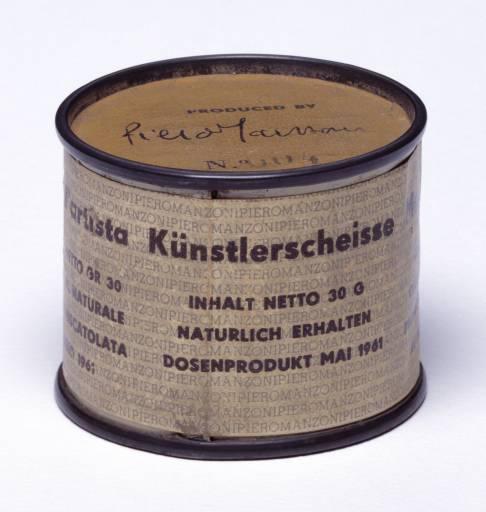 Piero Manzoni (1933-1963)
Artist's Shit 1961
Merda d'artista
Tin can with paper wrapping with unidentified contents
object: 48 x 65 x 65 mm, 0.1 kg
sculpture
Purchased 2000
From the Tate, which paid £22,300 ($61,000)
What did the artist say? "I should like all artists to sell their fingerprints, or else stage competitions to see who can draw the longest line or sell their s--- in tins," he wrote. "If collectors really want something intimate, really personal to the artist, there's the artist's own s---. That is really his."
The cans were sealed according to industrial standards and then circulated to different museums around the world.
In addition to the Tate, the Pompidou Museum in Paris and the Museum of Modern Art in New York have bought cans since. At least 45 of the original 90 cans have exploded, however. This is exactly what Manzoni intended. Soon after he created the cans he told a friend "I hope these cans explode in the vitrines of the collectors."
Thursday, October 20
Abort the Mission
I thought the headline read "Senators Grouse About Responses From Mars". So would they have wanted more support from Martians to stop their endless pettifogging and tell us straight out whether there is life (live Terry Schiavo fetuses?) on Mars or not?
Abort the Missionaries!
I'm a little tired, I guess.
Abort the Missionaries!
I'm a little tired, I guess.
He's Just Playing Politics (again)
All of the reporters on last week's State Week in Review panned Gov. Rod Blagojevich's plan to guarantee health insurance for all of the children of the state of Illinois. They argued that he's just introducing the plan now to get a lead in the polls, and that he has made no real suggestion on how to pay for it.
Wednesday, October 19
The World's Smartest Investor
In The Branding of the World's Top Intellectual: Noam Chomsky Peter Schweizer notes,
Chomsky, for all of his moral dudgeon against American corporations, finds that they make a pretty good investment. When he made investment decisions for his retirement plan at MIT, he chose not to go with a money market fund, or even a government bond fund. Instead, he threw the money into blue chips and invested in the TIAA-CREF stock fund. A look at the stock fund portfolio quickly reveals that it invests in all sorts of businesses that Chomsky says he finds abhorrent: oil companies, military contractors, pharmaceuticals, you name it.Well, as Tim Worstall says, he is the World’s Greatest Intellectual. (I invest in index funds that should show I'm almost as smart.)
When I asked Chomsky about his investment portfolio he reverted to a "what else can I do" defense: "Should I live in a cabin in Montana?" he asked. It was a clever rhetorical dodge. Chomsky was declaring that there is simply no way to avoid getting involved in the stock market short of complete withdrawal from the capitalist system. He certainly knows better. There are many alternative funds these days that allow you to invest your money in "green" or "socially responsible" enterprises. They just don't yield the maximum available return.
A Little Dry

4,000-Year-Old Noodles Found in China
October 12, 2005—A 4,000-year-old bowl of noodles unearthed in China is the earliest example ever found of one of the world's most popular foods, scientists reported today. It also suggests an Asian—not Italian—origin for the staple dish.
The beautifully preserved, long, thin yellow noodles were found inside an overturned sealed bowl at the Lajia archaeological site in northwestern China. The bowl was buried under ten feet (three meters) of sediment.
"This is the earliest empirical evidence of noodles ever found," Houyuan Lu of Beijing's Chinese Academy of Sciences said in an e-mail interview.
The scientists determined the noodles were made from two kinds of millet, a grain indigenous to China and widely cultivated there 7,000 years ago. Modern North American and European noodles are usually made with wheat.
Archaeochemist Patrick McGovern at the University of Pennsylvania in Philadelphia said that if the date for the noodles is correct, the find is "quite amazing."
Even today, he said, deft skills are required to make long, thin noodles like those found at Lajia.
"This shows a fairly high level of food processing and culinary sophistication," he said.
About 30 million starved to death
EnviroSpin Watch offers a 'Premier League Table of Deaths from Natural and Semi-natural Causes', but although he relies on Wikipedia, omits the world's most disastrous famine. The following is part of the Wikipedia entry for Great Leap Forward:
The Great Leap Forward is now widely seen both within China and outside as a major economic disaster. As inflated statistics reached planning authorities, orders were given to divert human resources into industry rather than agriculture. Various Western and Eastern sources put the death toll at about 30 million people, with the majority of the deaths owed to starvation.
Wait a Minute...
One of the things I'm not supposed to buy new is a car, but part of the subtitle of Tim Harford's book is "Why You Can Never Buy a Decent Used Car!" Books are another thing I shouldn't buy new according to the article, and in fact I usually don't.
Tuesday, October 18
Krugman protectionist?
Tim Worstall also castigates Paul Krugman:
Update
Awhile ago, I noted Alex Tabarrok linked to the same article. Sure, I'm senile.
...you, of all people, raising the ugly spectre of protectionism? What the hell happened? You used to be very good on such points. Like back in 1996 when you wrote Ricardo’s Difficult Idea.The link is to Krugman's defense of free trade.
Update
Awhile ago, I noted Alex Tabarrok linked to the same article. Sure, I'm senile.
The false consensus effect
John Tierney via Tim Worstall
"If people are engaged in deliberation with like-minded others, they end up more confident, more homogenous and more extreme in their beliefs," said Cass Sunstein, a law professor at the University of Chicago. "If you have an English or history department that leans left, their interactions will push them further left."And yet
Once liberals dominate a department, they can increase their majority by voting to award tenure to like-minded scholars. As liberals dominate a field, conservatives' work comes to be seen as fringe scholarship.
"The filtering out of conservatives in the job pipeline rarely works by outright blackballing," said Mark Bauerlein, a conservative who is an English professor at Emory. "It doesn't have to. The intellectual focus of the disciplines does that by itself."
Suppose, he said, you were a conservative who wanted to do a sociology dissertation on the debilitating effects of the European welfare state, or an English dissertation arguing that anticommunist literature from the mid-20th century was as valuable as the procommunist literature.
"You'd have a hard time finding a dissertation adviser, an interested publisher and a receptive hiring committee," Bauerlein said. "Your work just wouldn't look like relevant scholarship, and would be quietly set aside."
Social scientists call it the false consensus effect: a group's conviction that its opinions are the norm. Liberals on campus have become so used to hearing their opinions reinforced that they have a hard time imagining there are intelligent people with different views, either on campus or in politics. Last year professors at Harvard and the University of California system gave $19 to Democrats for every $1 they gave to Republicans.
Conservatives complain about this imbalance in academia, but in some ways they've benefited from being outcasts. They've been toughened by confronting skeptics on campus and working at think tanks in Washington involved in the political fray. They've come up with ideas -- welfare reform, school vouchers, all kinds of privatization schemes -- that have been adopted around the country and the world.So, it's a good thing for opponents of leftists that the academy has made itself irrelevant!
But how many big ideas from liberal academics are on anyone's agenda? Democratic politicians are desperately trying to find something newer than the New Deal to run on next year. They're glad to take campaign contributions from professors, but they're leery of ideas from intellectuals who've have been talking to themselves for so long.
Monday, October 17
Keep this in Mind
10 things you shouldn't buy new
- Books,
- DVDs, CDs and videos
- Little kids' toys
- Jewelry
- Sports equipment
- Timeshares
- Cars (For more, see "How to save $10,000 on your next car.")
- Software and console games
- Office furniture
- Hand tools
Friday, October 14
Is it the Bureacracy?
Megan Williams' Factories open — and close — in Swaziland is about how Swaziland is having trouble keeping textile manufacturers from pulling out. It reminded me of Tim Harford's note on Niger's bureaucracy. But there's no clue to Swaziland's bureaucracy here
Lots of classical music
Naxos is offering
I also downloaded the Beethoven symphonies from the BBC, even though
- Internet access to their entire catalogue for a year for $19.95.
- Free access to 25% of each track.
I also downloaded the Beethoven symphonies from the BBC, even though
Some from the recording industry expressed concerns that the BBC was setting itself up as unfair competition in the recording market.And now,
BBC Radio 3 will be celebrating Christmas 2005 by broadcasting continuously over ten days the complete works of Johann Sebastian Bach.(via Marginal revolution)
Subscribe to:
Posts (Atom)